ATS keywords by industry: the right terms for tech, healthcare, finance & more
ATS systems don't just filter by generic resume keywords — they filter by the specific vocabulary of each industry. A marketing resume needs "conversion rate optimisation" not just "marketing." A healthcare resume needs "HIPAA" not just "compliance." Using the right industry-specific language is what separates ranked candidates from invisible ones.
Your general resume keywords guide covers the principles. This article covers the practice — specific keyword lists by industry, drawn from the language that ATS systems and recruiters in each field actually search for.
How to use these lists
Don't copy every keyword from your industry section onto your resume. Instead:
- Use these lists to identify which industry terms are standard vocabulary in your field
- Cross-reference with the specific job posting you're applying to
- Add keywords that reflect skills you genuinely have
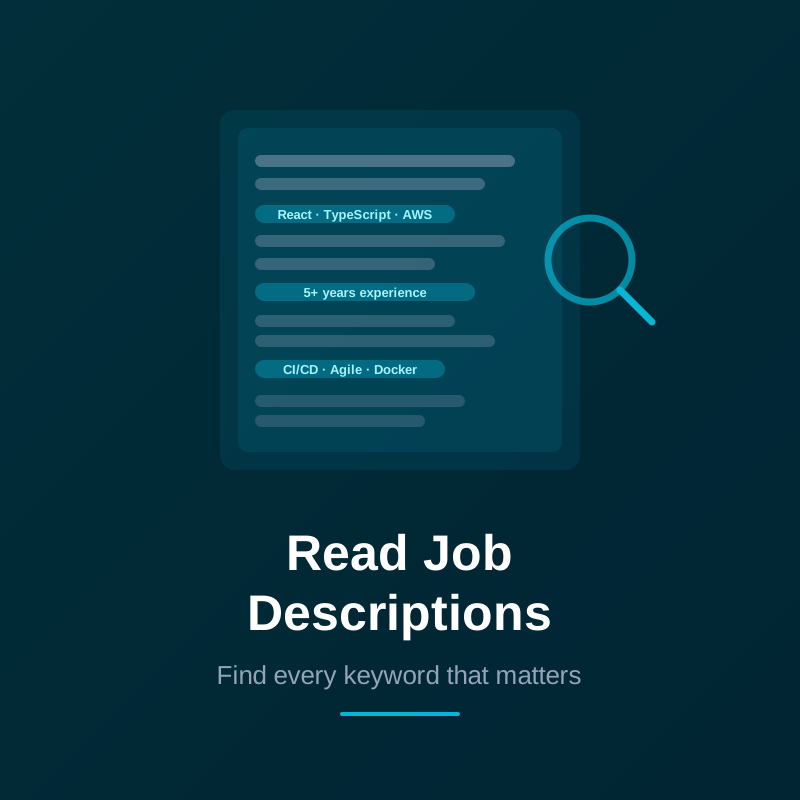
- Prioritise keywords that appear in the job posting itself — those are the ones that ATS is definitely filtering for
The job posting is always the primary source. These industry lists are a supplement to help you think more broadly.
Technology
Software engineering & development: Agile, Scrum, Kanban, CI/CD, DevOps, microservices, REST API, GraphQL, containerisation, Docker, Kubernetes, cloud-native, version control, Git, code review, unit testing, test-driven development (TDD), technical debt, refactoring, pair programming
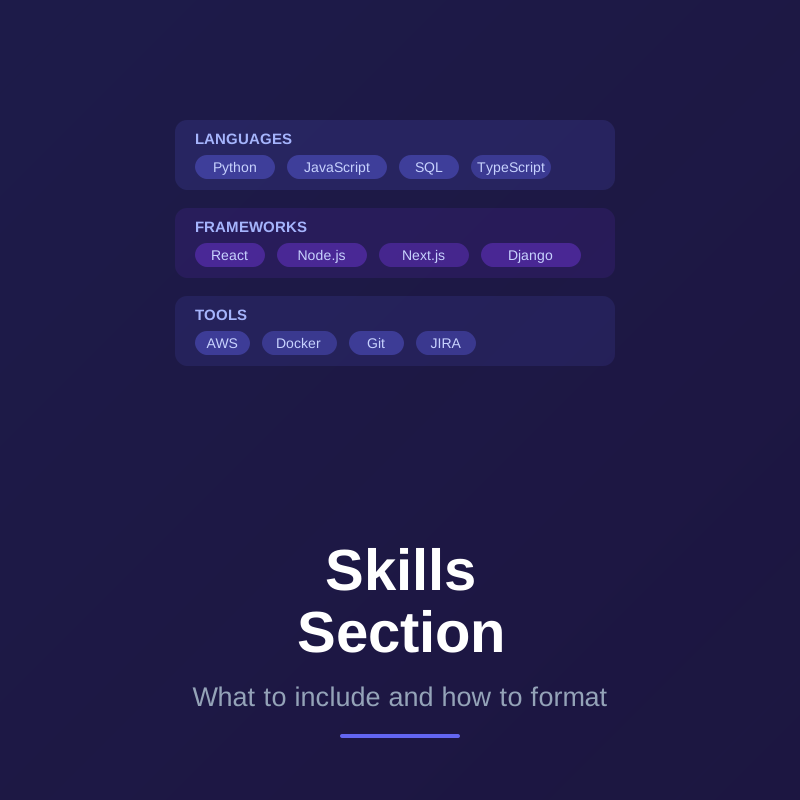
Languages & frameworks (include the ones you actually know): Python, JavaScript, TypeScript, Java, C++, Go, Rust, React, Node.js, Django, Spring Boot, .NET, SQL, NoSQL, PostgreSQL, MongoDB, Redis
Cloud & infrastructure: AWS (Amazon Web Services), Azure, Google Cloud Platform (GCP), Terraform, Infrastructure as Code (IaC), serverless, Lambda, EC2, S3, CloudFormation, load balancing, auto-scaling, observability, monitoring, Datadog, Prometheus, Grafana
Data & ML: Machine learning, deep learning, neural networks, NLP, computer vision, data engineering, ETL pipelines, data warehouse, data lake, Spark, Hadoop, Airflow, MLOps, model deployment, A/B testing, feature engineering, scikit-learn, TensorFlow, PyTorch
ATS tip for tech roles: List both the full name and abbreviation (e.g. "Amazon Web Services (AWS)"). Many ATS systems search for both and they may not match each other.
Healthcare & clinical
Clinical & compliance: HIPAA compliance, patient privacy, clinical documentation, electronic health records (EHR), electronic medical records (EMR), ICD-10 coding, CPT coding, OSHA compliance, Joint Commission standards, CMS regulations, infection control, medication administration
Nursing & allied health: Patient assessment, care planning, care coordination, interdisciplinary team, discharge planning, patient education, vital signs monitoring, wound care, IV therapy, phlebotomy, BLS, ACLS, PALS certification, telemetry monitoring
EHR platforms (name the specific ones you've used): Epic, Cerner, Meditech, Allscripts, PointClickCare, Athenahealth, Greenway Health
Therapy & rehabilitation: Physical therapy, occupational therapy, speech-language pathology, functional assessment, therapeutic exercise, manual therapy, home exercise programme, outcomes measurement, FIM scoring, DASH, LEFS
Healthcare operations: Revenue cycle management, medical billing, prior authorisation, claims processing, denial management, HEDIS measures, value-based care, population health, care management
ATS tip for healthcare: Licensing and certification keywords (RN, LPN, CNA, PT, OT, DPT) must appear in both abbreviated and full form. ATS systems may filter for either.
Finance & accounting
Accounting & audit: GAAP, IFRS, financial statements, general ledger, month-end close, year-end close, accounts payable, accounts receivable, reconciliation, journal entries, internal controls, SOX compliance (Sarbanes-Oxley), audit preparation, financial reporting, variance analysis, budget management
Tax: Tax compliance, tax planning, tax preparation, corporate tax, individual tax, tax returns, deferred tax, transfer pricing, R&D tax credit, state and local tax (SALT), international tax
FP&A & corporate finance: Financial planning and analysis (FP&A), forecasting, budgeting, financial modelling, DCF analysis, scenario analysis, management reporting, KPI dashboards, business partnering, cost analysis
Investment & banking: Portfolio management, asset allocation, risk management, equity research, fixed income, derivatives, due diligence, financial modelling (LBO, DCF, M&A), capital markets, Bloomberg Terminal, FactSet, pitch book
Software (name the ones you've used): SAP, Oracle Financials, NetSuite, QuickBooks, Sage Intacct, Microsoft Dynamics, Hyperion, Adaptive Insights, Anaplan, Workiva
Marketing & growth
Digital marketing: Search engine optimisation (SEO), search engine marketing (SEM), pay-per-click (PPC), Google Ads, Meta Ads, programmatic advertising, display advertising, email marketing, marketing automation, lead generation, conversion rate optimisation (CRO), landing page optimisation, A/B testing
Content & brand: Content strategy, content marketing, copywriting, editorial calendar, brand voice, brand guidelines, thought leadership, social media management, community management, influencer marketing, PR and communications
Analytics & data: Google Analytics, GA4, Adobe Analytics, data-driven marketing, attribution modelling, customer acquisition cost (CAC), customer lifetime value (LTV/CLV), return on ad spend (ROAS), marketing funnel, cohort analysis, customer segmentation
Marketing operations: HubSpot, Salesforce, Marketo, Pardot, Mailchimp, ActiveCampaign, CRM management, marketing qualified lead (MQL), sales qualified lead (SQL), pipeline management, campaign management
Product marketing: Go-to-market (GTM) strategy, positioning, messaging framework, competitive intelligence, product launch, sales enablement, market research, customer insights, ICP definition
Operations & supply chain
Operations management: Process improvement, Lean manufacturing, Six Sigma, Kaizen, continuous improvement, standard operating procedures (SOPs), KPI tracking, operational efficiency, capacity planning, workflow optimisation, root cause analysis
Supply chain: Supply chain management, procurement, vendor management, supplier relationship management, purchase orders, inventory management, demand forecasting, logistics, warehouse management, last-mile delivery, just-in-time (JIT), ERP systems
Project & programme: Project management, programme management, stakeholder management, risk management, change management, PMP certification, Agile methodology, Scrum, MS Project, Smartsheet, Jira
ERP & tools (name the ones you've used): SAP, Oracle EBS, NetSuite, Microsoft Dynamics, Infor, Manhattan Associates, Blue Yonder
Human resources
Core HR: Talent acquisition, recruiting, full-cycle recruiting, onboarding, employee relations, performance management, compensation and benefits, HR compliance, employment law, FLSA, FMLA, ADA compliance, EEOC, workforce planning
HR operations & systems: HRIS (Human Resources Information System), ATS management, payroll processing, benefits administration, compensation analysis, job description writing, organisational design, headcount planning
HR platforms (name the ones you've used): Workday HCM, SAP SuccessFactors, ADP Workforce Now, BambooHR, Rippling, Greenhouse, Lever, iCIMS, UKG (Kronos)
L&D and culture: Learning and development (L&D), employee engagement, culture building, diversity, equity, and inclusion (DEI), succession planning, leadership development, training design, LMS (learning management system)
A note on keyword context
Listing keywords in a skills section is necessary but not sufficient. ATS systems weight keywords more heavily when they appear in the context of actual work experience — not just as standalone items in a list.
"Python" in your skills section scores well. "Built a Python pipeline that processed 10M records daily" in your experience section scores higher, because it appears in context that confirms genuine usage rather than just claiming familiarity.
Use industry keywords in both your skills section and your experience bullets.
Frequently asked questions about industry ATS keywords
Should I use industry jargon or plain language? Industry jargon — when it's the correct technical term — is what ATS systems filter for. "EHR" is the right term in healthcare, not "digital patient records." Match the vocabulary of your field.
What if I'm changing industries? You need to acquire the vocabulary of the new industry. Review multiple job postings in your target field, note the recurring terms, and explicitly connect your existing skills to those terms. "Budget management" in manufacturing reads the same as "budget management" in finance — but "FP&A" and "variance analysis" may not appear naturally on a manufacturing resume.
How do I know which keywords are highest priority? Keywords that appear multiple times in a single job posting are highest priority. Keywords that appear across multiple job postings in your target role are foundational industry vocabulary. Both matter.
Is it okay to use American and British spelling variants? If you're applying to US roles, use US spelling (e.g. "optimization" not "optimisation"). ATS systems don't normalise spelling variants, and mismatches can reduce match scores.