Resume keywords: skills, writing, and CV guide
The right keywords for your resume can be the difference between landing an interview and automatic rejection.
What are resume keywords and why they matter
Resume keywords are specific words and phrases that describe the skills, qualifications, and experience required for a job. They're what ATS software scans for and what recruiters look for when skimming your resume.
When your resume contains the right keywords, you rank higher in ATS systems and catch the attention of human reviewers faster. Without them, even a strong candidate gets filtered out before a human ever reads the resume.
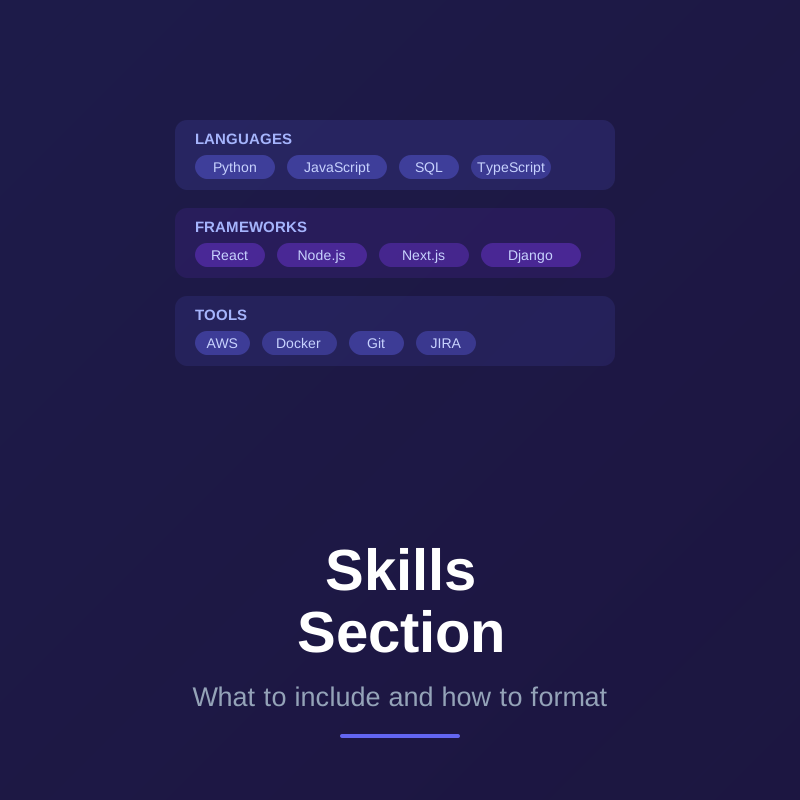
Keywords for resume skills: what to include
Your skills section is where keyword density matters most. ATS systems heavily weight this section when scoring your resume.
Hard skills keywords are specific, teachable abilities. Examples include:
- Programming: Python, JavaScript, React, SQL, AWS, Docker
- Data: Excel, Tableau, Power BI, Google Analytics, Looker
- Project management: Agile, Scrum, JIRA, Asana, PMP
- Marketing: SEO, Google Ads, HubSpot, Salesforce, CRM
- Design: Figma, Adobe XD, Sketch, Photoshop, Illustrator
Soft skills keywords are interpersonal and organizational abilities. Examples include:
- Leadership, cross-functional collaboration, stakeholder management
- Problem-solving, critical thinking, decision-making
- Communication, presentation skills, public speaking
- Time management, project coordination, prioritization
List only skills you genuinely have. Include both the full name and the common abbreviation where relevant — for example, "Search Engine Optimization (SEO)" — since different job postings use different versions.
Resume keywords by industry
The most effective keywords are job-specific, but knowing the standard terms in your field gives you a strong starting point.
Software engineering resume keywords: Python, JavaScript, TypeScript, React, Node.js, AWS, Docker, Kubernetes, CI/CD, REST APIs, GraphQL, microservices, test-driven development, Agile, Git, PostgreSQL, MongoDB, cloud infrastructure, system design, code review
Data and analytics resume keywords: SQL, Python, R, Tableau, Power BI, Excel, data modeling, ETL pipelines, machine learning, statistical analysis, A/B testing, Google Analytics, BigQuery, Snowflake, data warehousing, business intelligence, predictive modeling, data visualization
Marketing resume keywords: SEO, SEM, Google Ads, Meta Ads, email marketing, HubSpot, Salesforce, conversion rate optimization, A/B testing, content strategy, demand generation, lead generation, marketing automation, brand management, campaign management, copywriting, social media management
Finance and accounting resume keywords: Financial modeling, Excel, QuickBooks, SAP, budgeting, forecasting, variance analysis, GAAP, accounts payable, accounts receivable, financial reporting, cash flow management, audit, compliance, P&L management, cost analysis
Project management resume keywords: Agile, Scrum, PMP, JIRA, stakeholder management, risk mitigation, resource allocation, project planning, budget management, cross-functional teams, program management, change management, roadmap development, KPI tracking
Sales resume keywords: Salesforce, CRM, pipeline management, quota attainment, business development, account management, enterprise sales, SaaS, revenue growth, cold outreach, customer success, solution selling, lead qualification, contract negotiation
Operations resume keywords: Process improvement, Lean, Six Sigma, supply chain management, logistics, vendor management, ERP, operational efficiency, cost reduction, SLA management, workflow optimization, inventory management, quality assurance
Healthcare resume keywords: Patient care, HIPAA compliance, EMR, EHR, Epic, clinical documentation, care coordination, case management, patient education, medical coding, ICD-10, CPT codes, infection control, evidence-based practice
Resume keywords phrases: examples by job type
Single words are not enough. Recruiters and ATS systems also search for multi-word phrases. Here are resume keyword phrases that perform well across common roles:
Software engineer keyword phrases:
- Full-stack development, RESTful API design, CI/CD pipelines
- Test-driven development (TDD), microservices architecture, cloud infrastructure
- Code review, performance optimization, scalable systems
Marketing keyword phrases:
- Demand generation, conversion rate optimization, A/B testing
- Content marketing strategy, paid media management, email automation
- Brand positioning, go-to-market strategy, lead nurturing
Project manager keyword phrases:
- Program management, resource allocation, risk mitigation
- Cross-functional team leadership, budget management, stakeholder communication
- Agile methodology, sprint planning, roadmap development
Sales keyword phrases:
- Pipeline management, account executive, enterprise sales
- Revenue growth, quota attainment, business development
- Customer success, SaaS sales, solution selling
Match the exact phrases in the job description rather than paraphrasing them.
Keywords for job skills: hard vs. soft
When analyzing a job description, separate the keywords into two categories:
Keywords for job-required hard skills come from the requirements section. These are non-negotiable for ATS scoring. If the job lists "experience with Kubernetes," you need the word "Kubernetes" in your resume — not just "container orchestration."
Keywords for job-preferred soft skills appear throughout the posting in phrases like "you thrive in fast-paced environments" or "strong communicator." These are worth including in your summary and bullet points when genuine.
Focus your keyword effort on hard skills first. They carry more weight in ATS scoring.
Strong action verbs as resume keywords
Action verbs are also keywords. They signal what you did and how you contributed. Strong action verbs improve both ATS scoring and human readability.
Leadership and management: Led, managed, directed, oversaw, coordinated, supervised, mentored, coached, guided, delegated
Building and creating: Built, developed, designed, created, launched, established, implemented, introduced, engineered, architected
Improving and optimizing: Improved, optimized, streamlined, restructured, enhanced, accelerated, reduced, eliminated, modernized, automated
Analyzing and researching: Analyzed, evaluated, assessed, audited, identified, investigated, researched, measured, tracked, monitored
Collaborating and communicating: Collaborated, partnered, presented, advised, consulted, facilitated, negotiated, trained, onboarded
Achieving results: Delivered, generated, grew, increased, achieved, exceeded, surpassed, secured, saved, recovered
Use a different action verb for each bullet point. Repeating "managed" five times in a row weakens every bullet.
How many keywords should a resume have?
There's no perfect number, but a competitive resume typically matches 60–80% of the keywords in the job description. For a posting with 20 required skills, you want at least 12–16 of them present somewhere in your resume.
Don't count keywords mechanically. Focus on coverage: are all the major requirements addressed somewhere in your resume — skills section, work experience, or summary?
The skills section should list 10–20 relevant technical skills. More than 30 starts to look padded; fewer than 10 may look light for experienced roles.
Resume keywords for entry-level candidates
Entry-level resumes often have fewer technical keywords from work experience, but you can still build strong keyword coverage from:
- Coursework and projects: "Implemented a REST API using Node.js and PostgreSQL" covers multiple keywords naturally
- Internship experience: Even short-term work includes real tools and methodologies
- Certifications and training: AWS Certified Cloud Practitioner, Google Analytics Certified, HubSpot certifications all add credible keywords
- Skills from personal projects: Side projects, open-source contributions, and freelance work all count
Be specific and honest. "Familiar with React" is weaker than "Built a personal project using React and Firebase."
Where to find the right keywords
The job description is your primary source. Read it carefully and identify repeated terms, especially in the requirements and qualifications sections.
Hard skills and tools: Programming languages, software platforms, certifications, and technical competencies.
Soft skills: Leadership, communication, problem-solving, and teamwork.
Industry-specific terminology: Jargon and phrases unique to your field.
Action verbs: Words like managed, developed, implemented, or optimized that demonstrate what you've accomplished.
How to extract keywords systematically
Copy the job description into a document and highlight every skill, qualification, or requirement mentioned. Pay special attention to items in bullet-pointed requirements sections.
Look for repetition. If a term appears three times, it's critical. If it appears once, it's still relevant but lower priority.
Check both the must-haves and nice-to-haves. Include keywords from both sections if you genuinely have those qualifications.
To speed up this process, use the free keyword extractor tool — paste the job description and it ranks the must-have and nice-to-have keywords automatically in seconds.
Where to place keywords in your resume
Skills section: This is prime real estate for keyword matching. List your technical skills, tools, and competencies here using exact terms from the job description.
Work experience bullets: Incorporate keywords naturally into your accomplishment statements. Instead of saying "Led team projects," say "Led cross-functional team projects using Agile methodology" if that's what the job requires.
Summary or objective: Front-load your most important keywords in your opening paragraph where both ATS and humans will see them first. See the full guide on putting keywords in your summary for what specifically to include.
Certifications and education: Include exact certification names and relevant coursework that matches their requirements.
Keywords for resume writing: how to incorporate them naturally
Adding keywords to your resume is not the same as writing them well. The goal is keyword-rich content that reads like a confident professional wrote it — not like you pasted a job description into your experience section.
Use keywords in context, not in isolation. "Managed cross-functional collaboration" reads naturally. Repeating "cross-functional collaboration" three times in one bullet does not.
Let keywords drive your verb choice. If the job says "stakeholder management," open a bullet with a strong verb and build around that language: "Managed relationships with 12 stakeholders across engineering, marketing, and legal, aligning priorities across a $4M product roadmap."
Anchor keywords to specifics. "AWS" alone in a bullet is weak. "Deployed containerized microservices on AWS ECS, reducing infrastructure cost by 30%" hits the keyword while showing what you actually did.
Don't front-load your skills section with everything. A skills section that lists 40 items looks padded. 12–18 precise keywords that closely match the job posting are more effective than 40 vague ones.
The right test: read your resume aloud. If it sounds like a list of buzzwords, trim and reframe. If it sounds like you're describing real work you did, you've incorporated the keywords well.
Resume keyword examples: what good keyword usage looks like in practice
Knowing the keywords isn't the hard part. Knowing how to weave them into bullets that don't read like a keyword list is. Here are examples of the same experience written with weak vs. strong keyword integration:
Software engineer — weak:
Worked on cloud infrastructure and API development. Used Python and AWS.
Software engineer — strong (keywords in bold):
Architected REST API layer in Python and FastAPI, deployed on AWS ECS with auto-scaling, reducing average response time from 420ms to 90ms under peak load.
Marketing manager — weak:
Managed demand generation campaigns and worked on SEO.
Marketing manager — strong:
Led demand generation program combining SEO content strategy and Google Ads (£180K annual budget), generating 3,200 qualified leads at a 22% lower cost per acquisition than the prior year.
Project manager — weak:
Led cross-functional teams using Agile methods.
Project manager — strong:
Managed 4 cross-functional product teams of 18 people using Agile/Scrum, delivering 3 major releases on schedule and under budget with a stakeholder management cadence across engineering, design, and legal.
Data analyst — weak:
Created dashboards and reports using BI tools.
Data analyst — strong:
Built self-serve Tableau dashboards for 6 business units, replacing 14 hours/week of manual Excel reporting and enabling real-time A/B testing visibility for the growth team.
The pattern: the strong versions use the exact keywords while showing scope, tool specificity, and a measurable outcome. The keywords don't stand out as stuffed — they're doing the work of describing real accomplishments.
Trending resume keywords for 2026
Job postings evolve. Skills that weren't mentioned in postings 3 years ago now appear routinely. Here are the keyword categories gaining significant traction in 2026 job descriptions across common fields:
AI and automation skills (appearing across all industries):
- AI tools and workflows (general across roles — "experience with AI tools," "AI-assisted workflows")
- Prompt engineering (tech, content, and product roles)
- LLM integration, vector databases, RAG (engineering roles)
- AI literacy / AI collaboration (business and operations roles)
Data and analytics (broader adoption):
- dbt (data build tool) — appearing in analytics and data engineering roles
- Snowflake, Databricks — common requirements replacing older warehouse platforms
- "Data storytelling" — soft keyword increasingly listed in data analyst postings
Engineering (infrastructure and security emphasis):
- Platform engineering (replacing "DevOps" in many postings)
- FinOps / cloud cost optimization (engineering manager and senior IC roles)
- Zero trust security, SIEM (cybersecurity and engineering roles)
- TypeScript (has surpassed JavaScript in many frontend postings)
Business and operations:
- "Remote-first collaboration" / "async communication" (operational soft skills now explicitly listed)
- "Cross-functional influence" (replacing "cross-functional collaboration" at senior levels)
- ESG / sustainability reporting (finance, operations, and corporate roles)
How to use trending keywords: These are worth adding to your skills section and summary only if you genuinely have experience with them. Their value comes from their growing presence in job postings — if a term appears in 3 of the last 5 roles you've applied for, it's worth including where accurate.
CV keywords vs. resume keywords: any difference?
In the US, "resume" and "CV" are sometimes used interchangeably. The keyword strategy is the same either way: match the language of the job description, use industry-standard terms, and place them in the right sections.
Outside the US, a CV is typically longer and more detailed, which gives you more room to incorporate keywords naturally across publications, projects, and coursework sections.
The keyword stuffing trap to avoid
Never add keywords you don't actually have experience with just to game the system. If you claim expertise in a tool you've never used, you'll be exposed in the interview.
Don't create invisible text or repeat keywords unnaturally. Modern ATS systems can detect keyword stuffing, and human readers will find it off-putting.
Instead, be strategic and honest. If you have 8 out of 10 required skills, focus on highlighting those 8 prominently rather than inventing the 2 you lack.
Frequently asked questions about resume keywords
What are the best keywords to put on a resume? The best keywords are the ones that appear in the job description you're applying to. There's no universal "best" list — the right keywords depend entirely on the role. Start with the requirements section, highlight every technical skill and tool mentioned, and build your list from there.
Can I use the same keywords on every resume? Only for skills that are genuinely relevant to every role you apply to. Your core technical skills may stay consistent, but the emphasis, order, and phrasing should shift to match each posting. Using the exact language from each job description is more effective than maintaining one fixed keyword list.
How do I know which keywords the ATS is looking for? The job description is the ATS's keyword source. Whatever terms appear there — especially in the requirements section — are what the system is scoring against. Repeated terms are weighted more heavily, so prioritize those.
What if I don't have all the keywords a job requires? Focus on the keywords you do have and make them highly visible. If you're missing 2–3 minor requirements out of 15, that's usually acceptable. If you're missing most of the core requirements, it may not be the right fit — applying anyway rarely leads to interviews.
Are soft skills keywords worth including? Yes, but strategically. Soft skills like "leadership" or "cross-functional collaboration" matter when they appear in the job posting. Place them in your summary and work experience descriptions where they read naturally, not just listed in a skills section.
What are good keywords for job skills on a resume? The best keywords for your skills section are the exact tools, technologies, and competencies mentioned in the job description you're applying to. Keywords only work if your resume is properly formatted — check the ATS format guide. For software roles, this typically means specific languages (Python, TypeScript), frameworks (React, Django), cloud platforms (AWS, GCP), and methodologies (Agile, CI/CD). For business roles, it includes software platforms (Salesforce, HubSpot, Tableau) and process skills (stakeholder management, budget management, data analysis). Use the exact terminology from the posting — "customer relationship management" and "CRM" may be treated differently by ATS systems, so include both where space allows.
Test your keyword optimization
The only way to know if you've included enough relevant keywords is to compare your resume against the job description systematically. Tools that quantify your keyword match rate remove the guesswork and show you exactly what's missing.
When you can see a percentage score of how well your resume aligns with a specific job, you can make informed decisions about what to adjust rather than hoping you've covered everything.