
How to write resume bullet points that get noticed (with examples)
Your bullet points should tell a story of impact, not just list responsibilities.
The problem with most resume bullets
Most people write resume bullets that describe what they were responsible for, not what they actually achieved. Compare these two examples:
- "Responsible for managing social media accounts"
- "Grew Instagram following by 240% in 6 months through targeted content strategy, resulting in 15% increase in qualified leads"
The first tells you what the person did. The second tells you what happened because they did it. That's the difference that gets you interviews.
The formula for powerful bullets
Use this structure: Action verb + specific task + measurable result.
This is sometimes called the APR formula: Action + Project/Problem + Result. All three elements are required for a strong bullet:
- Action: What did you do? (Always an active past-tense verb — never "responsible for," never "I")
- Project/Problem: What were you working on or solving? (Be specific — tool, team size, context)
- Result: What happened because of your action? (Quantified outcome, or specific qualitative change)
APR in practice:
| Element | Example |
|---|---|
| Action | "Redesigned" |
| Project | "the customer onboarding flow in React and Figma" |
| Result | "reducing time-to-activation from 14 days to 4 days" |
| Full bullet | "Redesigned the customer onboarding flow in React and Figma, reducing time-to-activation from 14 days to 4 days" |
If a bullet is missing its Result element, it reads like a job description ("Redesigned the onboarding flow"). If it's missing specifics in the Project element, it reads like a claim ("Reduced onboarding time by 3x"). The full APR combination is what makes a bullet credible and compelling.
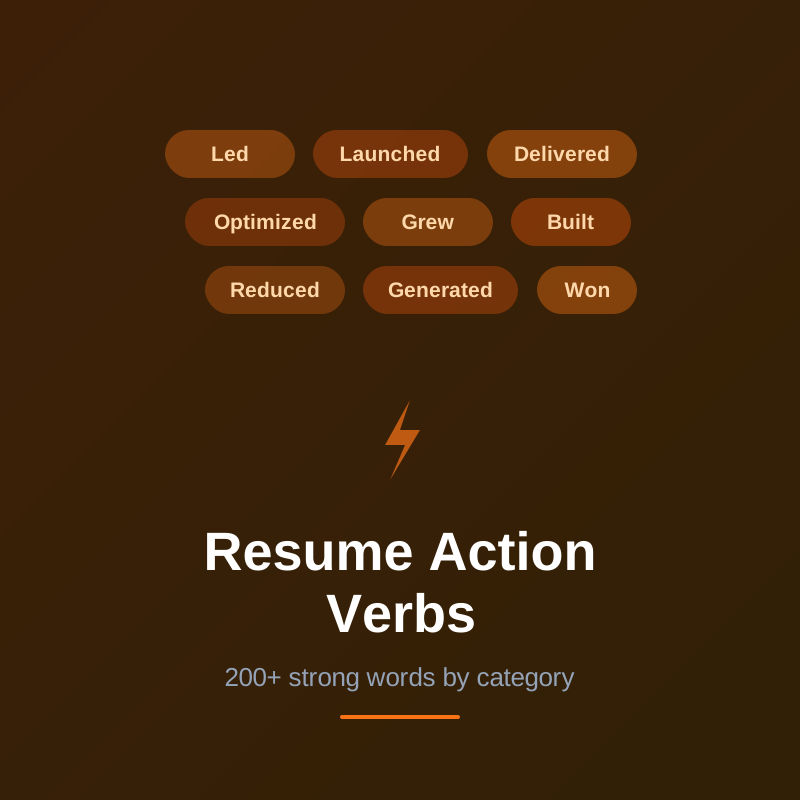
Start with a strong action verb: Avoid weak verbs like "helped," "worked on," or "responsible for." Instead, use powerful verbs that demonstrate initiative: developed, launched, optimized, generated, reduced, accelerated, transformed.
Include specific context: What exactly did you do? Don't say "improved processes." Say "redesigned onboarding workflow by implementing automated email sequences."
Quantify your impact: Numbers make your achievements concrete and credible. Use percentages, dollar amounts, time savings, or other metrics that show the scope of your contribution.
Examples across different roles
For software engineers:
- Weak: "Developed features for mobile app"
- Strong: "Built and deployed 12 user-facing features using React Native, reducing app crash rate by 35% and improving user retention by 20%"
For marketing professionals:
- Weak: "Managed email campaigns"
- Strong: "Launched automated email nurture campaign that generated $180K in revenue from dormant leads with 28% open rate and 12% conversion rate"
For project managers:
- Weak: "Led cross-functional teams on various projects"
- Strong: "Coordinated 5-person cross-functional team to deliver product launch 2 weeks ahead of schedule, resulting in $2M first-quarter revenue"
For sales roles:
- Weak: "Exceeded sales targets"
- Strong: "Surpassed annual sales quota by 145%, closing $1.2M in new business across 23 enterprise accounts in competitive SaaS market"
For data analysts:
- Weak: "Worked with data and created reports"
- Strong: "Built automated reporting pipeline in Python and SQL that reduced monthly reporting time from 3 days to 4 hours, enabling faster executive decision-making"
For operations roles:
- Weak: "Improved supply chain processes"
- Strong: "Redesigned vendor evaluation process, reducing procurement cycle time by 40% and saving $320K annually through renegotiated supplier contracts"
For finance roles:
- Weak: "Prepared financial reports and forecasts"
- Strong: "Developed 3-year financial model in Excel that identified $1.8M in cost savings, directly informing the company's restructuring plan"
For healthcare roles:
- Weak: "Provided patient care and documentation"
- Strong: "Managed care coordination for 45-patient caseload, reducing readmission rate by 18% through improved discharge planning and follow-up protocols"
For customer success roles:
- Weak: "Managed accounts and helped with renewals"
- Strong: "Maintained 94% renewal rate across a $2.4M portfolio of 60+ enterprise accounts by building quarterly business review cadence and proactive escalation process"
What to do when you don't have numbers
Not every accomplishment comes with neat metrics, but you can still demonstrate impact. Focus on scope, complexity, or outcomes.
Instead of numbers, describe the scale: "Led training program for 200+ new hires across 5 office locations."
Highlight efficiency or quality: "Redesigned customer onboarding process, reducing average time-to-value from 14 days to 6 days."
Emphasize recognition: "Selected to represent engineering team at company-wide summit for product innovation."
Use before/after comparisons even without exact numbers: "Replaced manual weekly reporting process with automated dashboard, eliminating 4+ hours of manual work per week."
50 strong action verbs for resume bullets
Choosing the right opening verb sets the tone for the entire bullet. Here are strong options by category:
Building and launching: Built, developed, designed, engineered, architected, launched, created, established, deployed, shipped
Leading and managing: Led, managed, directed, oversaw, supervised, coordinated, facilitated, spearheaded, championed, drove
Improving and optimizing: Improved, optimized, streamlined, accelerated, enhanced, reduced, eliminated, restructured, modernized, automated
Analyzing and solving: Analyzed, identified, diagnosed, evaluated, investigated, assessed, modeled, forecasted, researched, audited
Growing and achieving: Grew, increased, generated, delivered, exceeded, surpassed, achieved, secured, expanded, scaled
Collaborating and communicating: Partnered, collaborated, presented, advised, consulted, trained, mentored, onboarded, negotiated, influenced
Start each bullet with a different verb. Using "managed" five times in a row weakens every bullet in the list.
Common bullet point mistakes to avoid
Starting with "I": Bullet points never start with "I." Jump straight to the action verb.
Being too vague: "Improved performance" means nothing. Improved what? By how much? For whom?
Listing responsibilities instead of achievements: "Responsible for weekly reporting" tells a recruiter what your job was, not what you contributed. Reframe as: "Redesigned weekly reporting process, reducing preparation time by 60%."
Using the same verb repeatedly: Leads to monotony and signals limited impact variety. Vary your verbs to show breadth.
Making bullets too long: Aim for 1–2 lines per bullet. If it's spilling to a third line, cut it. The most powerful bullets are often the shortest.
Lying or exaggerating: Inflated numbers get caught in interviews. If your exact number isn't impressive, reframe the context instead. "Reduced bug backlog from 200 to 12 in 3 weeks" is more credible than inventing a big revenue figure.
How many bullets per job?
For your most recent and relevant positions, use 3–5 bullet points. For older or less relevant roles, 2–3 bullets are sufficient. Your most recent position should always have the most detail since it's what employers care about most.
If you held a role for many years, you don't need to list every single thing you did. Focus on your biggest wins and most relevant accomplishments for the job you're targeting.
How to improve your existing resume bullet points
Improving existing bullets is faster than writing from scratch — you already have the raw material. Use this method:
Step 1: Flag bullets that describe duties, not outcomes. Any bullet starting with "Responsible for," "Helped," "Worked on," or "Participated in" is a candidate for improvement. These describe what your job was, not what you contributed.
Step 2: Ask "so what?" for each bullet. "Managed social media accounts" → so what? → "grew the audience" → by how much? → "by 40% in 6 months." Now you have a real bullet: "Grew Instagram following 40% in 6 months through targeted content strategy, generating 15% increase in qualified leads."
Step 3: Replace the verb. Swap weak verbs (managed, handled, worked on, helped) for action verbs that describe what you did: launched, built, reduced, automated, led, designed, engineered.
Step 4: Add one specific detail. Vague context weakens even good bullets. Add the tool, the team size, the timeline, or the scale: "for a 50,000 MAU platform," "across a team of 8 engineers," "using Python and Airflow."
Step 5: Delete bullets that don't pass the "any qualified candidate" test. If every person who held your job attended the same meetings and used the same tools, it's not a selling point — it's a job description. Delete it.
A single strong bullet is worth five weak ones. Focus on improving your top 2–3 bullets per role before touching anything else.
Resume bullet points without numbers: how to show impact when you can't quantify
Not every role comes with dashboards and KPIs. Healthcare, education, legal, early-stage startups, and support roles often have real impact that's hard to put a number on. Here's how to write strong bullets without faking metrics.
Use scope instead of percentages:
- "Managed a 45-patient caseload with complex co-morbidities across two inpatient units"
- "Supported 3 legal teams across 12 active litigation matters simultaneously"
- "Led onboarding for 200+ new employees across 4 office locations in 18 months"
Use before/after framing:
- "Redesigned intake process, reducing average wait time from 3 weeks to 4 days"
- "Replaced paper-based tracking system with Notion — eliminated 6 hours of weekly manual reporting"
Use qualitative outcomes with specificity:
- "Developed curriculum for the company's first structured management training program, adopted as standard for all promotions"
- "Resolved a long-standing vendor dispute that had blocked two product launches for 14 months"
Use recognition and selection:
- "Selected as the only junior analyst to present findings at the annual partner retreat"
- "Chosen to represent the engineering team in cross-company architecture review"
Use frequency and reliability signals:
- "Maintained 99.4% on-time delivery record across 3 years and 600+ client orders"
- "Zero critical incidents in 18 months managing 24/7 on-call rotation for production infrastructure"
The key: specificity makes bullets credible even without percentages. Vague qualitative claims ("improved quality," "enhanced processes") are weak. Specific qualitative claims ("reduced average patient wait time from 3 weeks to 4 days") are strong.
Tailor your bullets to each application
The same experience can be framed different ways depending on what the employer values. If you're applying to a company that emphasizes innovation, highlight your creative problem-solving and new initiatives. If they value efficiency, emphasize cost savings and process improvements.
This doesn't mean lying or inventing achievements. It means choosing which of your real accomplishments to emphasize based on what each employer cares about most.
Frequently asked questions about resume bullet points
How long should a resume bullet point be? One to two lines maximum. If a bullet runs to three lines, it's almost always possible to cut without losing meaning. Shorter bullets get read; long bullets get skimmed and missed.
Should every bullet have a number or metric? Ideally, yes — but not at the cost of accuracy. If a genuine number isn't available, use scope, comparison, or outcome instead. A well-framed bullet without a number beats a vague bullet with a made-up one.
What's the best action verb to start a bullet? The best verb is the most accurate one. "Architected" is stronger than "built" when you actually designed the system. "Generated" is stronger than "helped with" when you were directly responsible. Choose precision over impressiveness.
Should I use past or present tense? Use past tense for all previous jobs. Use present tense only for your current role. Be consistent within each role.
Can I use bullet points in my summary section? Better not to. Your summary reads more naturally as 2–3 sentences of prose. Save bullet points for your work experience section where they're expected and easier to scan.
Should resume bullet points end with periods? No — resume bullet points typically do not end with a period. This is standard practice across most professional resume formats. The most important thing is consistency: if you use periods, use them on every bullet. If you don't (which is more common), omit them throughout. Mixing periods and no periods within the same resume looks unpolished.
Get feedback on your impact
The challenge with writing your own bullets is that it's hard to know if you're being compelling or underselling yourself. When you have tools that show you how well your experience matches what employers want, you can refine your bullets with confidence instead of guesswork.
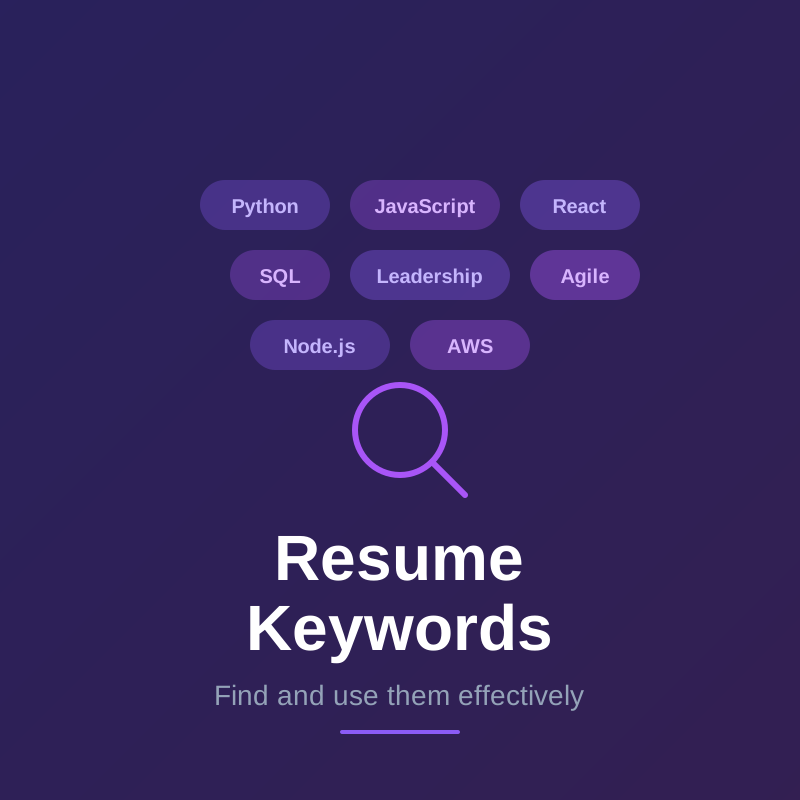
Seeing real-time feedback on keyword usage and achievement framing helps you write bullets that work for both ATS systems and the humans who make hiring decisions.