Entry-level software engineer resume guide (new grad & fresher)
Without work experience, your projects, skills, and education have to do the heavy lifting. A well-structured resume makes all three look as strong as possible.
The entry-level software engineer resume challenge
Most resume advice assumes you have years of work history to draw from. For entry-level engineers, that's not the case. You may have a degree, some personal projects, a bootcamp, and possibly one or two internships.
The good news: hiring managers at tech companies expect this. They're evaluating your potential, your technical fundamentals, and your ability to learn — not your years of experience. Your resume needs to show them all three.
The right structure for an entry-level engineer resume
For candidates with limited work experience, order your sections to lead with your strongest material:
- Contact information (name, email, phone, GitHub, LinkedIn, portfolio)
- Summary (optional but recommended — 2 sentences targeting the specific role)
- Skills (technical stack — this is your strongest ATS keyword section)
- Projects (often more relevant than your work history)
- Education (degree, bootcamp, relevant coursework)
- Work Experience (internships, part-time, unrelated jobs — include what you have)
- Certifications (if any)
This is the reverse of the standard resume structure. For most candidates, work experience leads. For entry-level engineers, your skills and projects are usually stronger proof of ability.
How to write a strong skills section with limited experience
Your skills section is the primary ATS scoring surface. Be specific and honest.
Include:
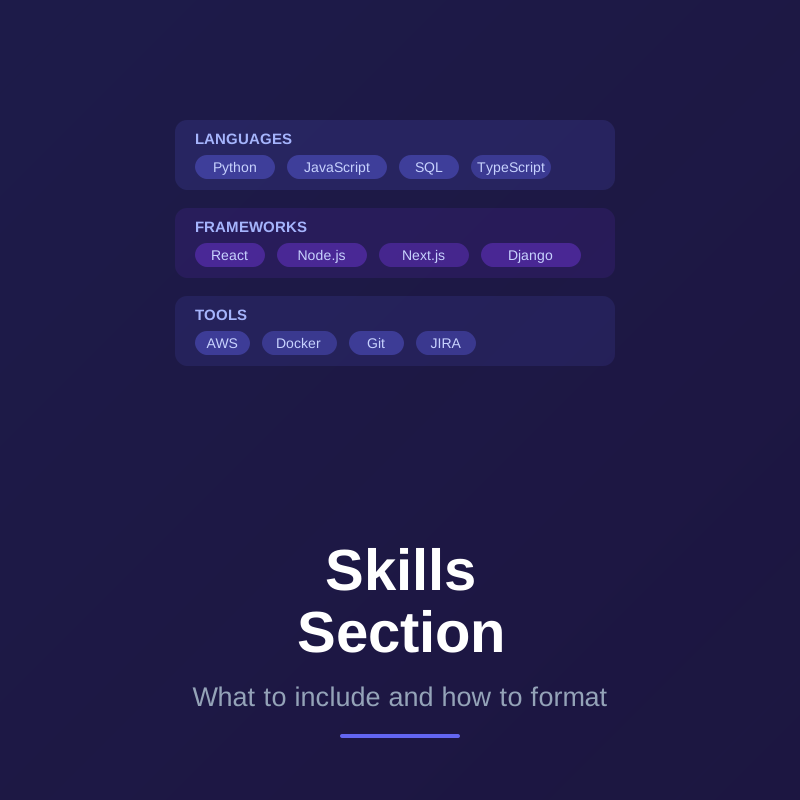
- Programming languages you can write working code in: Python, JavaScript, TypeScript, Java, C++, Go, Rust
- Frameworks you've used in projects: React, Vue, Next.js, Django, Flask, Express, Spring Boot
- Tools you actively use: Git, GitHub, Docker, VS Code, JIRA, Postman
- Databases you've worked with: PostgreSQL, MySQL, MongoDB, SQLite, Firebase
- Cloud or infrastructure if applicable: AWS (even S3/EC2 basics), Vercel, Heroku, GCP
- Methodologies: Agile, Scrum (if your bootcamp or coursework used them)
Don't include:
- Tools you've only watched tutorials about without writing code
- Every language you've ever opened a file in
- Soft skills ("hardworking," "team player") — these don't help ATS and waste space
Example skills section:
Languages: JavaScript, TypeScript, Python, HTML, CSS Frameworks & Libraries: React, Node.js, Express, Django Tools: Git, GitHub, Docker, VS Code, Postman, Figma Databases: PostgreSQL, MongoDB, Firebase Other: REST APIs, Agile, CI/CD basics, AWS (S3, EC2)
How to present personal projects on your resume
Projects are the most important section for entry-level engineers. They're proof that you can build something real, not just pass a course.
What makes a strong project entry:
- Clear title and a 1-line description of what it does
- Tech stack listed explicitly (these are keywords)
- 2–3 bullet points describing what you built and any measurable outcome
- GitHub link (and live demo link if available)
Weak project entry:
Weather App — Built using React. Shows weather data.
Strong project entry:
WeatherNow — Real-time weather dashboard with city search and 5-day forecast
- Built with React, TypeScript, and the OpenWeatherMap API; deployed on Vercel
- Implemented custom hooks for API calls and local state caching, reducing redundant fetches by 80%
- 200+ GitHub stars; refactored to use React Query after initial release to improve data consistency [github.com/yourname/weathernow] [weathernow.vercel.app]
The strong version shows tech stack (ATS keywords), shows you made real decisions (not just followed a tutorial), and has some form of measurable outcome.
How many projects to include:
- 2–3 strong projects is ideal
- One full-stack or complex project + one or two smaller focused ones
- Quality over quantity — a 3-project section with strong entries beats a 6-project section with weak ones
What counts as a project:
- Personal side projects (best)
- Capstone or bootcamp projects
- Open-source contributions
- Hackathon projects
- Course projects (if they involved real implementation, not just following a walkthrough)
How to write about internships and part-time work
Even a short internship is valuable. Even unrelated work experience can be reframed to show relevant skills.
For tech internships: Treat like a regular job entry. Describe what you built, the tech stack, and any impact you can quantify. Even "contributed to a codebase used by 10,000 users" is meaningful.
Example:
Software Engineering Intern — Acme Corp (Jun 2024 – Aug 2024)
- Built REST API endpoint in Node.js for user notification preferences, reducing support tickets related to this feature by 30%
- Participated in daily standups and 2-week Agile sprints, contributing to 3 production releases
- Wrote unit tests using Jest, increasing test coverage for the auth module from 42% to 78%
For unrelated work experience: Keep it brief (1–2 lines, no bullets) or leave it out if space is tight. Exception: if the work demonstrated directly relevant skills (communication, management, customer-facing problem-solving), include 1–2 targeted bullets.
How to present your education
Include:
- University name, degree, and graduation year (or expected graduation)
- GPA if 3.5 or above and within 2 years of graduation
- Relevant coursework (especially for roles where specific CS fundamentals matter): Data Structures, Algorithms, Operating Systems, Databases, Distributed Systems
- Any academic awards, honors, or relevant extracurriculars
Don't include:
- GPA below 3.0 (simply omit it)
- Unrelated coursework
- High school (if you have a university degree)
For bootcamp graduates: List your bootcamp as an education entry with dates, the program name, and what you built. Also include your degree if you have one.
Full-Stack Web Development Bootcamp — App Academy (2024) Intensive 1,000-hour program covering JavaScript, React, Python, Flask, PostgreSQL, and software engineering practices. Built 3 full-stack projects including a capstone app deployed to production.
The summary for entry-level engineers
Keep it short (2 sentences max) and specific to the role you're applying for.
Generic (avoid):
Computer science graduate looking for an entry-level software engineering role to apply my skills and grow.
Specific (use this):
Computer science graduate with hands-on experience building full-stack React and Node.js applications through internships and personal projects. Passionate about backend systems and API design; comfortable with Python, PostgreSQL, and Docker.
Mention the specific technologies you want to use (this helps ATS) and the type of role you're targeting (frontend, backend, full-stack, mobile).
Software engineer resume summary and objective examples
Whether to use a summary or objective depends on context: a summary describes who you are and what you bring; an objective describes what you're looking for. For entry-level candidates, a short hybrid works best.
Frontend focus (React + TypeScript):
Recent CS graduate with 2 internships building production React and TypeScript applications. Excited to join a product-focused team working on high-traffic consumer interfaces.
Backend focus (Python/API):
Computer science graduate specializing in backend development with Python, FastAPI, and PostgreSQL. Built 3 full-stack projects including a REST API serving 500+ daily users; looking for a backend engineering role at a data-intensive company.
Full-stack / generalist:
Full-stack engineer (bootcamp graduate, 2024) comfortable with JavaScript, React, Node.js, and SQL. Built and deployed 2 full-stack applications to production; focused on writing maintainable code and learning from experienced engineers.
Mobile (React Native / Flutter):
Computer science graduate with experience building cross-platform mobile apps using React Native. Shipped a personal iOS/Android app with 200+ downloads; eager to contribute to a mobile-first product team.
New grad with internship:
Software engineering intern at Acme Corp (2024), where I contributed to a payment processing API used by 50,000 monthly active users. CS graduate, May 2025; focused on backend systems and distributed architecture.
Fresher / no internship:
CS final-year student with strong foundations in data structures, algorithms, and web development. Built and deployed 4 projects using Python, Django, React, and PostgreSQL; seeking a junior software engineering role to contribute to production systems from day one.
Key rules for all of these:
- Mention at least 2–3 specific technologies (these are ATS keywords)
- State what type of role you want (frontend/backend/mobile/full-stack)
- Be honest — don't claim "expert" or "proficient" unless you genuinely are
- Keep it to 2–3 sentences maximum
GitHub, portfolio links, and contact info: what to include
Your contact block is prime real estate for entry-level engineers because it's where you compensate for limited work history with proof of work.
What to include in your contact block:
- Name, email, phone
- GitHub URL — always include if you have code worth showing. Format it as
github.com/yournamenot the full URL with https:// - LinkedIn URL — use your custom URL (
linkedin.com/in/yourname) - Portfolio site — if you have one, include it. Especially valuable for frontend or full-stack candidates
- Live demo links — can be listed within project entries rather than the contact block
GitHub profile tips:
- Pin your 3–4 strongest projects
- Each pinned repo should have a clear README explaining what it does, the tech stack, and how to run it
- Green contribution graph matters less than clean, readable code in your pinned repos
- A GitHub profile with 10 empty repos or only forked projects is worse than no link
What if you have no GitHub? If your best work lives elsewhere, link to it:
- Deployed app URL (
yourproject.vercel.apporyourproject.netlify.app) - CodePen or CodeSandbox for frontend demos
- Kaggle profile for data science projects
- itch.io for game development
If you have truly nothing to link to, the most impactful thing you can do before your next application is spend a weekend pushing your best project to GitHub with a clean README.
Hybrid resume format for entry-level engineers: Standard resume format puts work experience first. For entry-level engineers with limited professional history, a hybrid format works better: Skills and Projects appear before Work Experience. This ensures a recruiter sees your most relevant content immediately rather than a short list of internships or unrelated jobs.
The structure shown earlier in this guide (Skills → Projects → Education → Work Experience) is this hybrid format. It's widely accepted for tech roles and signals that you understand what matters in a technical evaluation.
Passing ATS as an entry-level engineer
Entry-level roles at large companies can receive hundreds or thousands of applications, and ATS filtering is aggressive. Tips specific to entry-level:
Mirror the job description precisely: If the job says "React" and "Node.js," those exact terms need to appear in your skills section. If they list "RESTful APIs," use that phrase in your project descriptions.
Use full names and abbreviations: "JavaScript (JS)" or "PostgreSQL (Postgres)" covers both variants.
Don't use tables or columns for your layout: Even if a template looks clean, ATS parsers will scramble multi-column content. Single-column layout only.
Submit as .docx unless specifically asked for PDF.
Resume tips for new grads and fresher software engineers
If you're a recent graduate (new grad) or a fresher engineer applying for your first role with no professional experience, the standard resume advice needs some translation.
What "no experience" actually means in tech: Most entry-level software engineering roles expect you to have built things, not managed teams or shipped to millions of users. Your projects and coursework are legitimate experience — present them with the same structure as a work history entry.
New grad resume priorities (in order):
- Technical skills that match the role — this is your primary ATS scoring surface
- 2–3 strong personal or academic projects with GitHub links
- Your degree (institution, major, graduation year, relevant coursework)
- Any internship, co-op, or part-time technical work
- Academic achievements (dean's list, hackathon wins, relevant club leadership)
Fresher software engineer resume tips: For candidates in markets where "fresher" is the standard term for a first-time job seeker (India, Southeast Asia, and others), the structure is the same but emphasis differs:
- Include your CGPA or GPA if it's above 7.5/10 or 3.5/4.0
- List your final-year or capstone project prominently — it's often your strongest technical signal
- Add a "Relevant Coursework" subsection under Education if it includes CS fundamentals (Data Structures, Algorithms, DBMS, OS, Networks)
- Technical skills section is critical: list languages, frameworks, and tools from your coursework and personal projects, using exact names (Python, not "scripting languages")
- Include internship projects even if they were short (4–8 weeks) — real-world codebases count
The key mindset shift: You're not competing with people who have 5 years of experience. You're competing with other new grads and freshers. Your differentiators are: what you've built, how clearly you communicate it technically, and whether your resume shows you think like an engineer — not whether you've done it professionally yet.
Frequently asked questions about entry-level software engineer resumes
Should I include a GitHub link on my resume? Yes, always — if your GitHub has code worth showing. Make sure your pinned repositories are your strongest projects and that READMEs are written clearly. A GitHub profile with empty repos or only forked projects is worse than no link.
What if I have no internship experience at all? Lead with projects. Three strong personal projects built with relevant technologies will demonstrate ability more concretely than job titles can. Also consider contributing to open-source projects before you apply — even small contributions show real-world collaboration.
Should I list every programming language I know? Only languages you can comfortably write working code in. "Familiar with" languages belong in a sentence in your summary at most — not in your core skills section, where they'll be treated as full proficiencies.
Is a one-page resume required for entry level? Yes, almost always. With limited work history, a two-page resume typically means you're padding with weak content. Keep it tight on one page.
Do I need a cover letter as an entry-level candidate? A strong cover letter can help differentiate you when your work history is thin. Use it to explain what draws you to the specific company or role, and to connect your projects to their tech stack. Keep it to 3 short paragraphs.