Teacher resume: how to write one for any education role
Teaching is one of the most credential-heavy professions in any hiring market. Schools receive dozens of applications for every open position, and principals and HR staff filter hard on certification status, subject endorsements, and grade-level experience before they read a single bullet point.
A teacher resume is not just a list of schools you've worked at. It needs to communicate your certifications, your subject expertise, the grade levels you've taught, and — critically — evidence that students in your classroom actually made progress.
This guide covers the structure, content, and language that gets teachers shortlisted.
What school hiring managers look for first
Before reading your experience, most principals and HR leads will check:
- Teaching certification status. Are you state-certified? For what grades and subjects? Is it active?
- Endorsements and content areas. Elementary general, secondary math, special education, ESL/ELL — these determine whether you're eligible for the role at all.
- Grade level match. K-2 experience doesn't automatically qualify you for a high school posting.
- Any prior administrative or department lead experience (for senior roles).
Make all of this visible immediately — in a certifications block near the top of your resume, not buried in an education section.
Structure for a teacher resume
- Contact information
- Teaching certifications & endorsements (near the top)
- Professional summary (3–4 sentences)
- Teaching experience (reverse chronological)
- Education
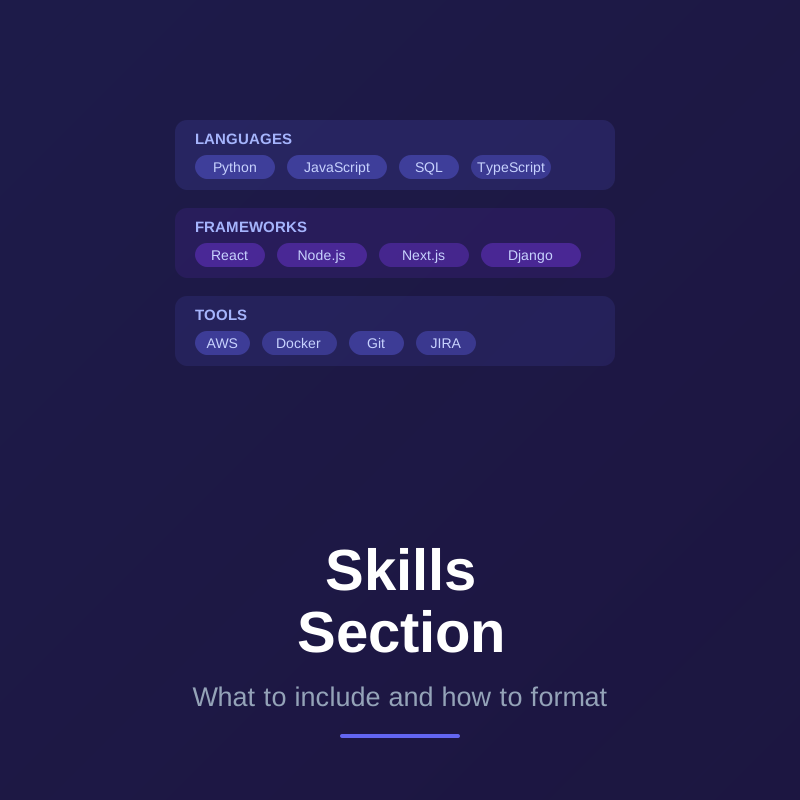
- Skills
- Professional development / additional training (optional)
Certifications and endorsements: how to list them
Each certification entry should include:
- Certification name and level
- State(s) issued
- Licence number (optional but useful)
- Expiry or renewal date
Example:
Teaching Certificate — Secondary Education, Mathematics (Grades 7–12) State of Illinois — Licence #1234567 — Valid through 06/2028
ESL/ELL Endorsement State of Illinois — Added 2022
Paraprofessional Certification Illinois State Board of Education — 2019
If you hold a Highly Qualified Teacher (HQT) designation or a National Board Certification (NBCT), list these prominently — they're significant differentiators.
Teaching experience: how to write compelling bullets
The most common weakness in teacher resumes is vague language that describes activities instead of outcomes.
Weak:
Taught 5th grade math and literacy. Created lesson plans and assessed students.
Strong:
Delivered differentiated math and ELA instruction to 28 5th-grade students across 3 ability levels. Implemented a targeted intervention programme that moved 14 students reading below grade level to on-level by year end, as measured by spring DIBELS benchmarks.
More strong bullet examples:
- Designed and taught an AP Chemistry curriculum for 60 juniors and seniors; AP exam pass rate of 84%, 12 percentage points above the school district average.
- Built a project-based learning unit on local history that increased student engagement scores by 31% on end-of-unit surveys and won a district innovation award.
- Led IEP team meetings for 9 students with learning disabilities, collaborating with special education staff, parents, and counsellors to set and track annual goals.
- Managed a mixed-level ESL classroom of 22 students (beginner to intermediate) and advanced 18 students to the next proficiency level within one academic year.
Data you can reference: standardised test scores (MAP, SBAC, DIBELS), grade averages, attendance rates, behavioural referral reductions, AP/IB pass rates, parent satisfaction surveys.
Skills section for teachers
Instructional skills:
- Differentiated instruction, backward design, UDL (Universal Design for Learning)
- Formative and summative assessment, data-driven instruction
- IEP development and implementation, 504 coordination
- Project-based learning (PBL), inquiry-based learning
- Culturally responsive teaching
Subject expertise: List the specific subjects and grade levels you're qualified and experienced to teach. Be precise: "Secondary Mathematics (Algebra I, Geometry, Precalculus)" beats "Mathematics."
Technology:
- Google Classroom, Canvas, Schoology, Seesaw
- Microsoft Teams, Zoom (for remote/hybrid instruction)
- Smart Boards, Nearpod, Kahoot, iReady, Khan Academy
Administrative & collaborative:
- Curriculum development, lesson planning
- Parent communication, IEP team participation
- Department chair or team lead experience (if applicable)
Education section for teachers
List your degree with your subject area and institution clearly stated:
Bachelor of Science in Education — Secondary Mathematics University of Wisconsin-Madison — 2018
Master of Arts in Teaching (MAT) — Special Education DePaul University — 2021
If your degree is in a non-education field and you completed an alternative certification route, explain it briefly:
Bachelor of Arts — English Literature Boston University — 2016 Teaching Certification obtained through Massachusetts Alternative Route programme, 2018.
Resume summary examples for teachers
Elementary teacher:
Certified K-6 elementary teacher with 5 years of experience in Title I schools. Specialised in literacy intervention and differentiated instruction. Consistent record of moving below-grade-level readers to proficiency within one academic year. Passionate about culturally responsive teaching and family engagement.
Secondary math:
Illinois-certified secondary mathematics teacher (Grades 7–12) with 8 years of experience teaching Algebra through AP Calculus. Data-driven approach to instruction with a track record of above-district-average AP exam pass rates. Experienced department chair and curriculum writer.
New teacher / student teacher:
Completing a Bachelor of Science in Education (Elementary, Grades 1–6) at Ohio State University, with 14 weeks of student teaching across 2nd and 4th grade classrooms. Ohio teaching licence in progress. Experienced with Google Classroom, iReady, and positive behaviour support strategies.
Tailoring your teacher resume for different roles
Unlike most professions, teacher hiring is hyperlocal. A resume that works for a suburban district won't necessarily land interviews in a Title I urban school, a private school, or a charter network.
Title I / high-need schools: Emphasise intervention experience, knowledge of MTSS/RTI frameworks, and any data literacy credentials.
Private or independent schools: Highlight extracurricular involvement, coaching, advising, or club sponsorship. These schools value the whole-educator model.
Charter networks: Use outcomes-focused language. Charter schools tend to screen heavily for data-driven instruction experience.
International schools: Include any experience with IB, Cambridge, or international curriculum frameworks. Language skills are a strong differentiator.
Frequently asked questions about teacher resumes
Should I include all my student teaching placements? Yes, especially if you're a new teacher. List each placement separately with the school name, grade level, and subject area, and include 2–3 bullets of what you actually did.
How long should a teacher resume be? One page for teachers with under 5 years of experience. Two pages is standard and acceptable for experienced teachers with multiple roles, endorsements, and professional development.
Do I need a cover letter for teaching jobs? Almost always. School hiring committees typically read cover letters carefully. Your cover letter should address the school's mission and your philosophy directly — more so than in corporate hiring.
What if I'm changing from another career into teaching? Lead with your alternative certification status and relevant subject expertise. Highlight any tutoring, mentoring, coaching, or curriculum-adjacent experience. Bridge the gap explicitly in your summary.