ATS cover letter: how to write one that actually gets read
Most cover letters are either ignored by ATS or skipped by recruiters. A well-written one can be a meaningful differentiator — but only if it clears both filters first.
Does ATS scan cover letters?
Yes — but inconsistently. Some ATS platforms parse cover letters alongside resumes and include keywords from both when scoring candidates. Others ignore the cover letter entirely and score only the resume. Most ATS systems that do scan cover letters give the resume significantly more weight.
The practical implication: optimize your resume first. The cover letter is a secondary document. But since some systems do scan it, and since a human will read it if your resume passes, it's worth writing well.
When a cover letter actually matters
Cover letters are worth writing carefully when:
- The job posting specifically requests one
- You're applying to a role where written communication is part of the job (content, marketing, copywriting, product management, consulting)
- You're making a career change and need to explain your pivot
- You have a gap or unusual background that benefits from context
- You have a personal connection or specific reason for targeting this company
Cover letters matter less for:
- High-volume applications at companies with automated screening
- Technical roles where skills and GitHub portfolio speak for themselves
- Roles where the application form makes it clear the cover letter is optional and rarely read
ATS-friendly cover letter format
The same formatting rules that apply to resumes apply to cover letters:
Use a plain, single-column layout. No tables, text boxes, or creative designs. ATS reads text linearly.
Save as .docx if submitting as a separate file, or paste as plain text if the application form has a text field.
Don't put your cover letter in the header. Some candidates create a document with both resume and cover letter — if you do this, make sure the cover letter content is in the main body, not in a Word header element.
Keep the file name clean: "Firstname-Lastname-CoverLetter-CompanyName.docx" is clean and professional.
Length: One page. Three to four short paragraphs. Recruiters don't read long cover letters.
How to include keywords in your cover letter
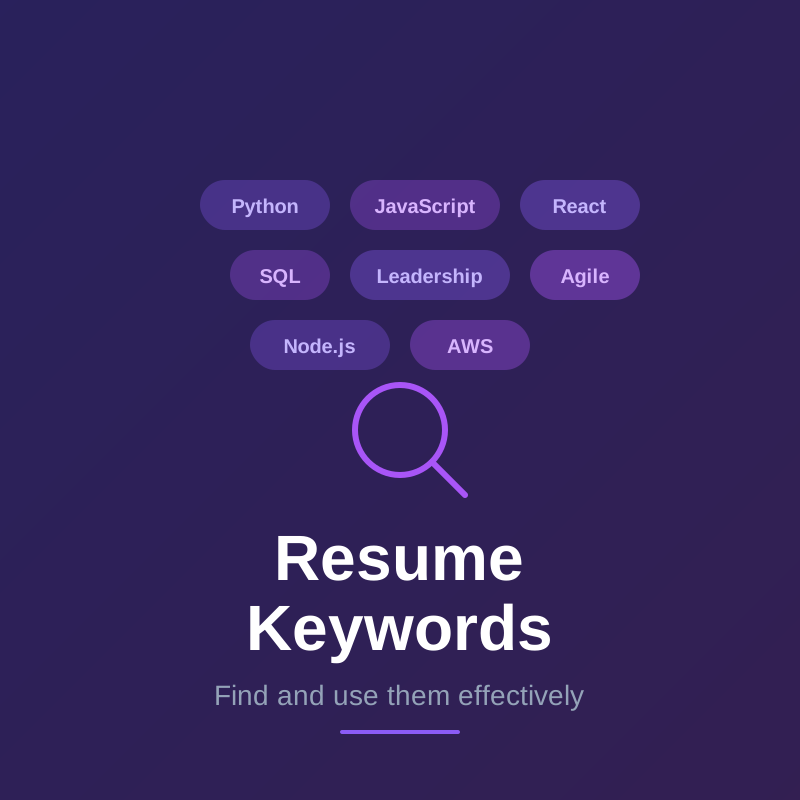
Since ATS systems that scan cover letters look for the same keywords as resumes, incorporate 4–6 of the most important keywords from the job description naturally into your letter.
The keyword strategy is the same: mirror the exact language from the job description rather than paraphrasing. If the job says "product-led growth," use that phrase — not "product-driven growth" or "growth through the product."
Where to place keywords in a cover letter:
- Opening paragraph: Mention the role title and 1–2 core required skills
- Second paragraph: Describe a relevant achievement using job-description language
- Third paragraph: Connect your background to their specific context
Don't keyword-stuff. A cover letter read like a keyword list instead of a letter will fail with human reviewers even if it passes ATS.
The structure of an effective ATS cover letter
Opening paragraph — who you are and why you're here
State the role you're applying for and give one specific reason you're interested. Avoid generic openers ("I am writing to express my interest in..."). Be direct.
Generic:
I am writing to apply for the Senior Product Manager position at Acme Corp. I believe I would be a great fit for this role.
Specific:
I'm applying for the Senior Product Manager role at Acme Corp. I've followed your product-led growth strategy for the past year and I'm interested in contributing to a team that's built genuine retention into the core product experience.
Second paragraph — one specific relevant achievement
This is the most important paragraph. Pick one achievement that directly relates to a key requirement in the job posting. Use numbers if you have them.
In my current role at [Company], I led the team that redesigned our onboarding flow based on a 6-week discovery sprint. The redesign reduced time-to-first-value from 14 days to 5, and 30-day activation improved from 38% to 61%. We did it with a team of 3, which meant prioritizing ruthlessly and shipping incrementally — something I understand is core to how your team operates.
Third paragraph — connection to this company specifically
Why this company, not a competitor? Be honest and specific. Generic "I'm passionate about your mission" statements waste this paragraph.
What draws me specifically to Acme is your approach to [specific product decision / company strategy / team structure]. I've read your engineering blog posts on [topic] and I respect how deliberately you've approached [challenge]. I want to work somewhere that thinks that carefully about [thing that matters to you].
Closing — a direct ask
Short. Confident. No excessive gratitude.
I'd welcome the chance to talk through how my background in [relevant area] fits what you're building. Happy to jump on a call whenever works.
Before and after: full cover letter example
Generic (avoid):
Dear Hiring Manager,
I am writing to apply for the Software Engineer position at your company. I have 4 years of experience in software development and I believe I would be a great addition to your team. I am a hardworking, team-oriented individual with strong communication skills.
I have experience with many programming languages and frameworks. I am a fast learner and I adapt well to new technologies. I am looking for an opportunity to grow my skills and contribute to exciting projects.
Thank you for considering my application. I look forward to hearing from you.
Specific (use this):
Hi [Hiring Manager's Name],
I'm applying for the Senior Frontend Engineer role at Acme. I've been building with React and TypeScript for 4 years and I'm particularly interested in this role because of your focus on design systems and component performance — two areas I've spent the last 18 months working on deeply.
At my current company, I led the build of an internal design system used by 6 product teams. Getting cross-team adoption required both the technical work (theming, accessibility, documentation) and a lot of stakeholder alignment. The result was a 40% reduction in UI inconsistencies flagged in QA and significantly faster feature development across teams. I'd bring that same combination of technical execution and cross-functional thinking to Acme.
I've followed how your team has approached [specific technical decision or blog post] and I'm curious to work somewhere that thinks carefully about developer experience at that level. Happy to connect whenever works.
[Name]
The second version names specific technologies (ATS keywords), shows a specific quantified achievement, connects to the company specifically, and reads like a real person wrote it.
Frequently asked questions about ATS cover letters
Should I address the cover letter to a specific person or "Hiring Manager"? Use a specific name whenever you can find one (LinkedIn, the job posting, the company website). "Dear [Name]" is always better than "Dear Hiring Manager" and significantly better than "To Whom It May Concern."
What if the application form has a text box for a cover letter — should I paste plain text? Yes — paste your cover letter as plain text, removing any special formatting. Text fields in application forms don't render Word formatting and some ATS systems parse plain text more cleanly.
Should I write a cover letter if it says "optional"? If you have the time and the application is for a role you genuinely want, yes. A well-written optional cover letter can differentiate you. A generic one provides no value and wastes the reader's time.
How different should my cover letter be from my resume? Very different in form, tightly connected in content. Your resume is a structured list of facts and achievements. Your cover letter is a narrative that connects two or three of those facts to this specific job. Don't repeat your resume in paragraph form — that's the most common cover letter mistake.