Graphic designer resume: how to balance portfolio and ATS
Graphic designers face a paradox: the instinct is to create a beautifully designed resume that shows off your skills. But heavily designed resumes — multi-column, icon-heavy, infographic-style — are among the worst-performing formats for ATS systems. The resume that looks the most impressive in print often gets rejected before a human sees it.
This guide explains how to write a designer resume that passes ATS, earns a second look from a human reviewer, and lets your portfolio carry the visual weight it's meant to.
The ATS problem with designed resumes
Most graphic designers apply to companies that use ATS — agencies, in-house design teams, studios, and corporate communications departments. ATS systems extract text from your resume and attempt to match it to job keywords.
Here's what breaks ATS parsing on designer resumes:
- Multiple columns: Text in sidebars is often read out of order or skipped entirely
- Text in images or icons: ATS cannot read text embedded in graphics
- Tables and text boxes: Some ATS systems skip table contents entirely
- Non-standard fonts: Can cause character rendering errors that corrupt text extraction
- Decorative headings: "About Me" instead of "Summary" confuses ATS section identification
A beautifully designed resume that fails ATS gets rejected before any human sees the design. Your portfolio handles the visual showcase — the resume handles the text-parsing gate.
The right approach: clean resume + strong portfolio link
The solution is not to abandon your design sensibility entirely — it's to apply it with constraint.
Resume: Clean, single-column, ATS-readable. Well-structured whitespace and typography can still look polished without multi-column complexity. Your name and contact section can have subtle design touches.
Portfolio: This is where your design work speaks. A recruiter or creative director who reads a clean, credible resume will click through to your portfolio. A creatively designed resume that never gets parsed never gets that far.
Structure for a graphic designer resume
- Contact info + portfolio link (prominent)
- Professional summary (2–3 lines)
- Skills
- Work experience (reverse chronological)
- Education
- Certifications / software (optional — can merge with skills)
Put your portfolio link in the contact section, not buried at the bottom. Make it the second thing after your name and contact details. It's the most important thing on the page.
Portfolio link: how to present it
Portfolio: designerhandle.com Behance: behance.net/designerhandle LinkedIn: linkedin.com/in/yourname
Keep it clean and directly clickable. If your portfolio URL is long or hard to type, use a short custom URL (your name .com or a Squarespace/Adobe Portfolio custom domain).
Before you send any application: open your portfolio URL in an incognito window and make sure it loads, looks professional, and shows your best 4–6 pieces. An applicant tracking note that says "portfolio link leads to a 404" ends the application.
Work experience: how to write designer bullets
Designer resumes often describe process ("designed mockups and iterated with stakeholders") instead of outcomes. Go further.
Weak:
Created marketing materials and social media graphics for company campaigns.
Strong:
Designed all visual assets for a 6-month product launch campaign across digital, print, and OOH — 120+ deliverables across web banners, social posts, email templates, and signage. Campaign exceeded awareness target by 35% and was shortlisted for an industry design award.
More strong bullets:
- Led brand refresh for a 15-year-old fintech brand including new logo system, colour palette, typography, and 40-page brand guidelines; guidelines adopted across 6 regional offices.
- Designed and iterated UI for a mobile app onboarding flow (12 screens) in collaboration with UX and product teams; redesigned flow reduced drop-off at step 3 from 42% to 19%.
- Produced weekly motion graphics and social content for an Instagram account that grew from 8,000 to 52,000 followers over 14 months.
- Built and maintained a design system in Figma for a SaaS product, covering 200+ components; system reduced design handoff time by 50% and eliminated most development inconsistencies.
- Managed a 3-person junior design team across 8 concurrent client projects; introduced a Notion-based project tracker that reduced missed deadlines from 4/month to 0 over 6 months.
Skills section for graphic designers
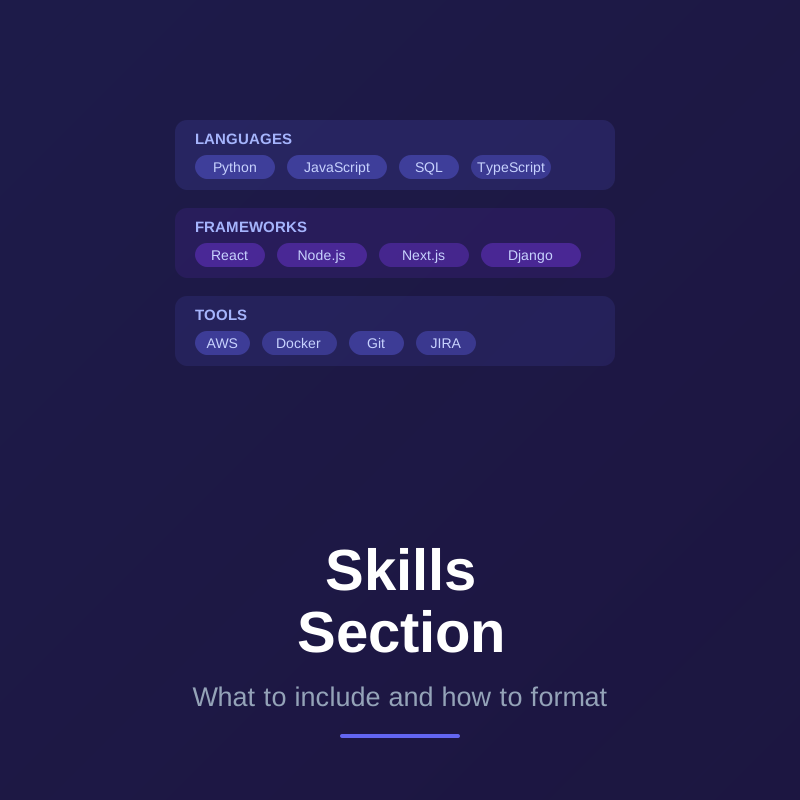
Design Software: Adobe Creative Suite (Photoshop, Illustrator, InDesign, After Effects, Premiere), Figma, Sketch, Canva Pro, Procreate Motion & Video: After Effects, Premiere Pro, Final Cut Pro, Lottie animations Print: Pre-press production, CMYK colour management, bleed/slug setup, print specifications, vendor coordination Digital: Web-ready asset export, responsive design principles, UI design, design systems, HTML/CSS (basic) Typography & Brand: Type pairing, grid systems, brand identity systems, brand guidelines development Collaboration: Figma (components, prototyping, dev handoff), Zeplin, InVision, Notion, Asana, Slack
Resume summary examples for graphic designers
Agency designer:
Graphic designer with 5 years of agency experience across brand identity, print, and digital campaigns. Adobe CC expert, strong in Figma for collaborative workflow. Comfortable managing multiple projects under tight deadlines. Portfolio: designerhandle.com
In-house brand designer:
Senior designer with 7 years of in-house experience at consumer brands. Specialised in brand systems, packaging, and marketing collateral. Led 2 full rebrand projects and managed a junior designer. Strong cross-functional communicator. Portfolio: designerhandle.com
Motion / digital:
Motion designer with 4 years of experience in digital advertising and social content. Proficient in After Effects and Premiere Pro. Produced 300+ motion assets annually across clients in SaaS, fintech, and e-commerce. Portfolio: designerhandle.com
Career progression (freelance to in-house):
Freelance graphic designer transitioning to an in-house role after 3 years of independent client work across branding, packaging, and digital. Comfortable working independently and collaborating within teams. Looking for a brand or marketing design role at a mid-size company. Portfolio: designerhandle.com
Passing ATS as a graphic designer
Designer ATS filters scan for:
- Software names: Adobe Photoshop, Illustrator, InDesign, Figma, Sketch — spell them out fully
- Design discipline keywords: brand identity, typography, motion graphics, UI design, packaging design, digital advertising — match the posting's language
- File and production terms: print production, pre-press, CMYK, vector, SVG, responsive design
- Collaboration tools: Figma (components, prototyping), Zeplin, InVision
The biggest ATS miss for designers: listing "Adobe CC" as a single skill instead of naming individual applications. ATS searches for "Adobe Illustrator," not "Adobe Creative Cloud."
When a designed resume is appropriate
There are situations where a designed resume is expected and appropriate:
- Direct email to a creative director who you know won't use ATS
- Portfolio submission as a PDF attachment where design is explicitly part of the evaluation
- Freelance pitches to design studios that want to see your aesthetic upfront
- Print design specialist roles where showing print production skills is part of the proof
In these cases, go ahead and design it. But have a clean ATS-readable version ready for any application going through an online portal.
Frequently asked questions about graphic designer resumes
Should I submit my resume as a PDF or Word doc? PDF, almost always. It preserves formatting across operating systems. The only exception is if the application explicitly requests a .docx file.
Is a one-page resume realistic for a designer with 8 years of experience? Not necessarily — two pages is fine for senior designers with substantial project history. But do not pad to fill two pages. A tight one-page resume for a mid-level designer is more impressive than a padded two-pager.
Can I include personal or passion projects on a designer resume? Yes. Especially for designers earlier in their careers, personal branding projects, type specimens, or self-initiated work show initiative and creative range. Keep entries brief and link to portfolio pieces.
What if my portfolio isn't ready? Don't apply until it is — especially for creative roles. Hiring managers will click the link. An incomplete portfolio, a broken link, or a portfolio of low-quality work can disqualify you more decisively than a weak resume.