Resume for remote jobs: what to include and how to optimize it
Remote roles get significantly more applicants than in-office roles. Your resume needs to signal remote readiness from the first line.
How remote job applications are different
Remote job postings attract applicants from everywhere, not just a local radius. That means more competition — often 3–5x more applicants than a comparable in-office role. ATS filtering is correspondingly more aggressive, and recruiters spend less time per resume because there are simply more to review.
Two things follow from this:
- Your ATS keyword optimization needs to be airtight
- You need to signal remote-specific competencies that in-office candidates don't need to demonstrate
The ATS angle for remote roles
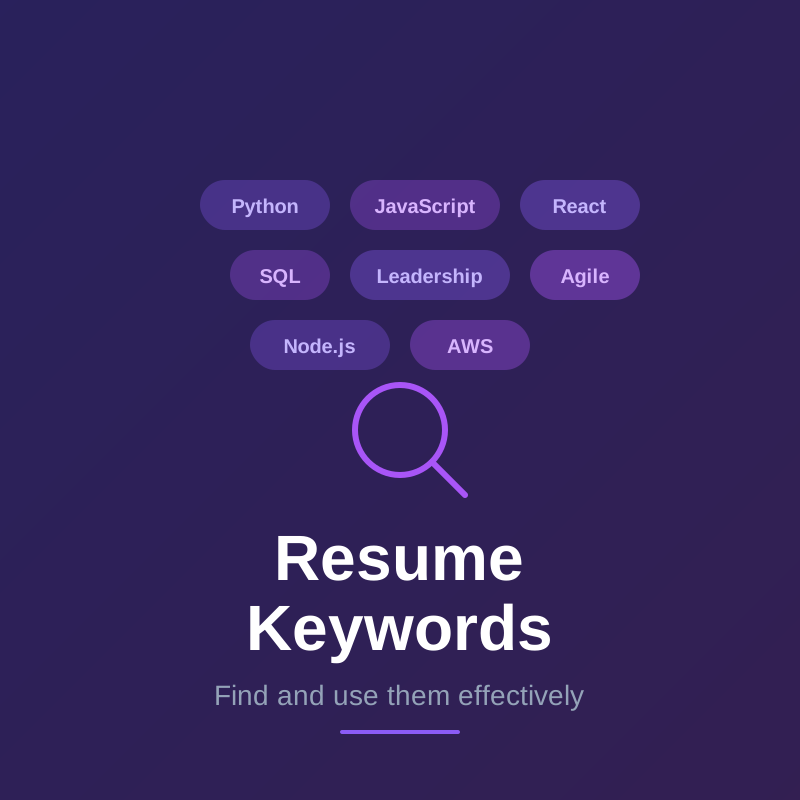
Many remote job postings include specific keywords that on-site roles don't: "remote," "async," "distributed team," "Slack," "Notion," "Loom," "time zone management," "self-directed," "remote-first."
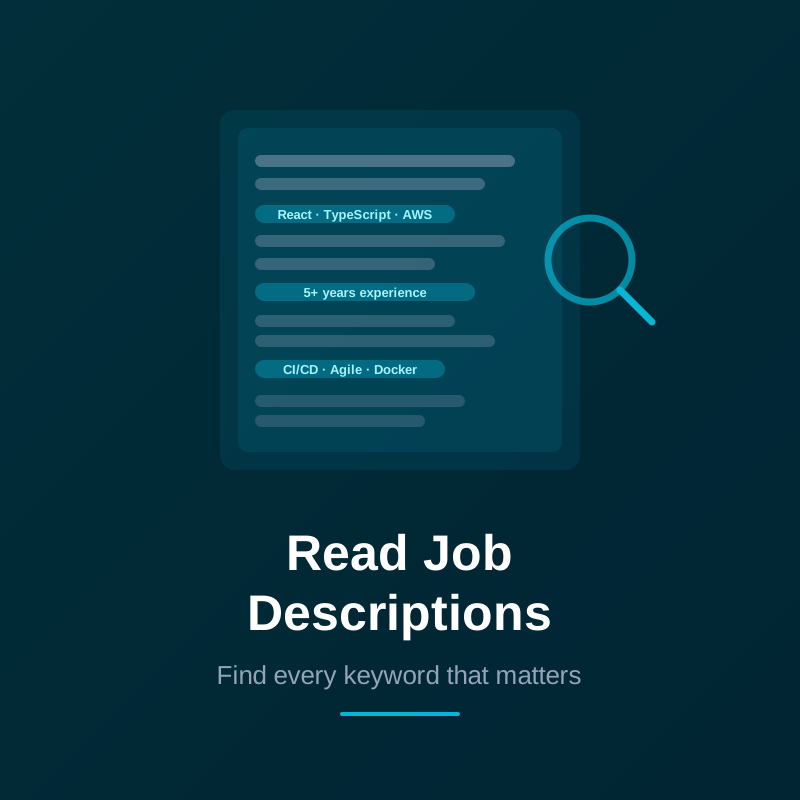
ATS systems score your resume against all keywords in the posting — including remote-specific ones. If the job description says "experience working in async environments" and your resume contains nothing about async work, you're missing a keyword match.
Read every remote job description carefully for these signals and incorporate them into your resume where genuine.
Your location on a remote resume
Include your city and country (or city and state if you're in the US) in your contact information. Don't include your full street address.
Label yourself as remote-ready by adding "(Open to remote)" or simply noting your timezone if the role is timezone-specific: "Based in Amsterdam (CET)" or "Austin, TX — Open to remote."
Some candidates list "Remote" as their location when they're actively working remotely: "New York, NY (Remote)" for their current role. This signals that remote isn't new to them.
Remote-specific keywords and skills to include
These terms appear in remote job postings and signal remote competency when included naturally in your resume:
Tools and platforms: Slack, Notion, Asana, JIRA, Confluence, Loom, Zoom, Google Meet, GitHub, Linear, Figma, Miro, Trello, ClickUp, Basecamp
Work styles and practices: Asynchronous communication, async-first, distributed teams, cross-timezone collaboration, remote-first culture, self-directed, autonomous, written communication, documentation
Soft skills with remote relevance: Clear written communication, proactive updates, time zone management, outcomes-focused, independent decision-making, async documentation
Only include terms that genuinely describe your work style. If you've never worked on a distributed team, don't claim expertise in "cross-timezone collaboration" — but if you've worked with colleagues in different offices or time zones, you can claim it accurately.
How to demonstrate remote experience in bullet points
Showing remote experience in your work history is more credible than claiming it in your skills section.
Examples of remote-relevant bullets:
Collaborated with distributed team of 11 engineers across 4 time zones, delivering product releases on 2-week sprint cadence with no co-located standup requirements
Authored comprehensive async documentation for onboarding process, reducing new hire ramp time from 6 weeks to 3 weeks for fully remote team
Led product discovery interviews with 40+ users across US, EU, and APAC time zones using Loom and Notion to synthesize findings asynchronously
Managed client relationships with 8 enterprise accounts across North America and Europe entirely via Slack and async video updates, maintaining 96% retention rate
Each of these demonstrates remote competency through specific, verifiable outcomes — not just claims.
What to emphasize in your resume summary
For remote applications, your summary should signal:
- The role and skills you bring (same as any resume)
- Your remote experience or readiness (if genuine)
Example summary for a remote application:
Senior product designer with 6 years of experience at fully remote SaaS companies. Skilled in async-first workflows using Figma, Notion, and Loom, with a track record of leading design sprints across distributed teams in 3+ time zones. Currently seeking a remote-first role where visual design and user research drive product decisions.
Example for someone with partial remote experience:
Data analyst with 4 years of experience including 2 years working remotely across a distributed analytics team. Proficient in SQL, Python, and Tableau, with strong written communication skills developed through async-first reporting and stakeholder updates. Seeking a fully remote role in data or business intelligence.
Should you apply to remote jobs if you haven't worked remotely before?
Yes — but be transparent. Claiming "extensive remote work experience" when you've only worked in offices is easy to verify and damages trust if caught.
Instead, position yourself as someone with strong independent work habits and async communication skills, even if they were developed in a hybrid or partially remote context. Specific examples are more persuasive than general claims.
If you're new to remote work, consider your side projects, freelance work, or any cross-location collaboration as supporting evidence.
Cover letter for remote applications
Remote job cover letters should explicitly address:
- Why remote work suits your work style (be specific, not generic)
- Your home office setup or work environment if relevant
- Any timezone or availability considerations
Keep it brief — 3 paragraphs is enough. Recruiters reading 200+ applications for a popular remote role aren't reading long cover letters.
Frequently asked questions about remote job resumes
Should I mention my home office or equipment on my resume? Only if the job posting explicitly asks about it. Some remote roles require specific equipment or a dedicated workspace — if they ask, address it in your cover letter, not your resume.
Do remote companies care about ATS optimization as much as in-office ones? Often more so, because the applicant volume is higher. Remote roles tend to use ATS more aggressively because they'd otherwise be buried in applications. Strong ATS optimization matters at least as much for remote as for in-office applications.
Should I use a different resume for remote vs. in-office applications? Yes — just as you tailor for each role, you should adjust your remote resume to include remote-specific terms when applying to fully remote roles, and de-emphasize those same terms for hybrid or in-office applications where they're less relevant.
What if a company is remote-first but doesn't mention it much in the job description? Check their company page and the tone of the posting. If they list async tools in the requirements or describe a distributed team, incorporate remote-relevant keywords. If it's ambiguous, a brief mention of your remote readiness in your summary won't hurt.