Resume with no experience: how to write one that gets interviews
Having no work experience doesn't mean having nothing to show. Every hiring manager knows that someone has to be first. The problem isn't that you lack experience — it's that most no-experience resumes lead with what's missing instead of what's there.
Whether you're a student writing your first resume, a new graduate with only internships, a career changer starting fresh, or someone re-entering the workforce — the challenge is the same: how do you fill a page with content that's compelling when you haven't held a relevant job yet?
This guide shows you exactly what to put on a no-experience resume, how to structure it, and how to make it pass ATS.
What "no experience" actually means to a hiring manager
Before writing a word, understand what employers actually mean when they say they want experience. They want evidence that you can:
- Show up reliably and do the work
- Learn what you don't know
- Communicate clearly
- Deliver something useful
None of those require a job title. They can come from coursework, projects, volunteering, freelance work, clubs, sports, caregiving, or even self-directed learning. The goal of a no-experience resume is to reframe what you've done as evidence of those qualities.
The right structure for a no-experience resume
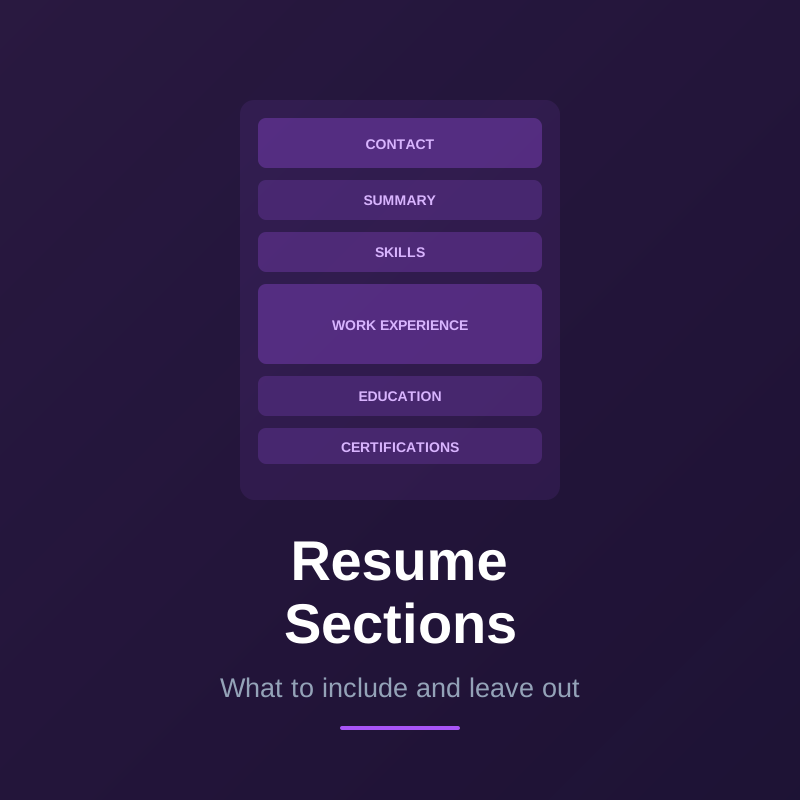
When you have limited work history, the standard "experience first" resume structure works against you. Use this order instead:
- Contact information
- Resume summary or objective (2–3 sentences)
- Education (move this up — it's your strongest credential)
- Projects / relevant work (academic, freelance, personal)
- Skills
- Work experience (even if part-time, seasonal, or unrelated)
- Volunteer work / extracurriculars (optional but useful)
Move your education section above your work experience. For anyone with limited professional history, your degree, coursework, and academic achievements are more relevant than a part-time retail job.
Education section: get more out of it
Most no-experience resumes list education as: degree, school, year. That's one line when it could be five.
Weak:
Bachelor of Science in Business Administration University of Arizona — 2026
Strong:
Bachelor of Science in Business Administration — Marketing Concentration University of Arizona — Expected May 2026 — GPA: 3.7 Relevant coursework: Consumer Behaviour, Digital Marketing Analytics, Marketing Strategy, Data Visualisation Dean's List: Fall 2024, Spring 2025 Senior capstone: Developed a full go-to-market strategy for a local non-profit; presented to a panel of 4 industry professionals
Relevant coursework, GPA (if above 3.5), academic honours, and a capstone or thesis project all belong here when you're light on work history.
Projects section: your most important section
For most no-experience candidates, projects are the equivalent of work experience. Treat them the same way.
For each project, include:
- Project name and what it was
- What you actually built, researched, or delivered
- Tools or methods used
- Any outcome or result (grade, impact, audience, usage)
Example entries:
E-commerce Website Redesign — Personal project, 2025 Redesigned UX and navigation for a small Etsy seller using Figma prototypes. Conducted 6 user interviews to identify pain points. Proposed changes reduced time-to-checkout by an estimated 40% based on usability testing.
Financial Literacy Workshop Series — University volunteer project, 2024 Developed and delivered 4 one-hour workshops on budgeting and credit to 60+ first-year students. Created all slide decks and handouts. Post-survey showed 78% of attendees felt "more confident" managing personal finances.
Sales Funnel Analysis — Marketing Analytics course project, 2025 Analysed a 6-month Google Analytics dataset for a simulated SaaS company, identified a 67% drop-off at the pricing page, and presented 3 data-backed recommendations to reduce churn.
The more specific and outcome-focused, the better. Hiring managers read these the same way they read job experience bullets.
How to write a resume summary with no experience
Don't write an objective that says "I am seeking a position where I can grow and develop my skills." That tells employers nothing about you.
Instead, write a summary that states:
- What you are (student, recent grad, career changer)
- What you bring (strongest skills, relevant coursework, relevant projects)
- What you're looking for (role type, industry)
Student / new grad:
Marketing student at the University of Arizona (graduating May 2026) with hands-on experience in Google Analytics, social media content strategy, and data visualisation. Completed 3 real-world project briefs through coursework. Seeking an entry-level digital marketing or analytics role.
Career changer:
Former high school teacher transitioning into instructional design and corporate L&D. 6 years of experience creating differentiated curriculum, facilitating group learning, and measuring outcomes. Completed a UX and instructional design certificate programme. Looking for a junior ID or content developer role.
Re-entering the workforce:
Operations professional returning to work after a 2-year caregiving period. Prior experience in logistics coordination and vendor management. Used the gap to complete a PMP certification and contribute 15 hours/week to a non-profit operations team. Ready for a full-time project coordination role.
Skills section: use it strategically
The skills section is where no-experience candidates can look more qualified than they feel. Every class, tool, and self-taught skill belongs here.
Group skills by type:
Technical: Google Analytics, Excel (pivot tables, VLOOKUP), Tableau, SQL (beginner), Canva, WordPress Languages: Spanish (conversational), French (basic) Soft skills: Public speaking, team facilitation, written communication, research and analysis
Only list skills you could be asked about in an interview. Don't pad with "Microsoft Word" unless the role requires document production.
Work experience: even unrelated jobs count
If you've had any paid work — retail, food service, babysitting, mowing lawns — it still belongs on a no-experience resume. What you're showing isn't the industry — it's that you've been trusted with responsibility, showed up reliably, and handled real-world situations.
Weak:
Cashier — Target, 2024–2025
Strong:
Cashier & Customer Service Associate — Target, June 2024–Present Handled 100+ customer transactions per shift in a high-traffic retail environment. Trained 3 new seasonal employees on POS systems and store procedures. Maintained top-3 customer satisfaction scores in the department for Q4 2024.
Even an unrelated job can show reliability, communication, and the ability to learn quickly — which is exactly what entry-level employers are hiring for.
Volunteer work and extracurriculars
These belong on a no-experience resume, especially if you had a leadership role:
- Club officer positions (treasurer, president, committee chair)
- Sports team captain
- Volunteer coordinator
- Event organiser
- Research assistant (unpaid)
Format them like jobs: title, organisation, dates, 2–3 bullets.
Passing ATS with a no-experience resume
ATS systems for entry-level roles typically filter on:
- Job title keywords in your summary (use "marketing analyst" or "software developer" not just "graduate")
- Hard skills and tools (exact names: Excel, Python, Salesforce — not "spreadsheets" or "CRM systems")
- Degree and field (spell out "Bachelor of Science in Computer Science" not just "CS degree")
- Location (especially for in-person roles)
Read the job description carefully and mirror its exact language throughout your resume. If the posting says "analytical skills and proficiency in Excel," your resume should say those things too.
Frequently asked questions
Should I use a one-page or two-page resume with no experience? One page. You don't have the history to justify two pages, and a sparse two-page resume looks worse than a full one-page resume.
Should I include my GPA? Yes, if it's 3.5 or above. If it's below 3.0, leave it off. If it's between 3.0 and 3.4, it's optional.
Is a resume objective or summary better with no experience? A summary is almost always better — it's forward-looking and tells the employer what you bring, not what you want. Write a 2–3 sentence summary instead of a one-line objective.
Can I lie about my experience to fill gaps? No. It's not worth the risk — background checks, reference calls, and interview questions will expose it. The strategies in this guide give you more than enough to work with honestly.
What if I genuinely have nothing — no jobs, no projects, no volunteer work? Create something before you apply. A small personal project (a website, a data analysis, a designed poster, a mock business plan) takes a weekend and gives you something real to write about. Employers value initiative.