What Is an ATS Score? Meaning, Scale & How to Improve It
Your ATS score determines whether a human ever reads your resume. Most candidates never see their score — but you can estimate and improve it before you apply.
What is an ATS score?
An ATS score is a match percentage calculated by an Applicant Tracking System that shows how well your resume aligns with a specific job description. When you submit a resume, the ATS compares the content of your resume against the keywords, qualifications, and requirements in the job posting — and produces a score that represents how closely they match.
This score is used to rank all applicants for a role. Recruiters typically see a sorted list of candidates, with the highest-scoring resumes at the top. In competitive hiring situations, only the top-ranked applications ever get read by a human.
Understanding how ATS systems work is essential context before diving into how scores are calculated.
ATS score meaning
Different ATS platforms use different names for the same concept. You may see it called:
- Match rate (Greenhouse, LinkedIn)
- Fit score (some iCIMS versions)
- Resume score (generic terminology)
- ATS score (common candidate-facing term)
- Match percentage (general)
Regardless of the label, the concept is consistent: a numerical representation of keyword and qualification alignment between your resume and the job description. Higher scores mean you're more likely to be reviewed by a human. Lower scores mean your application will fall below the review threshold.
What is a good ATS score?
A good ATS score depends on the platform and the competitive pool, but the general benchmarks hold across most systems:
| ATS Score Range | What It Means |
|---|---|
| Below 50% | Unlikely to reach human review for competitive roles |
| 50–70% | Borderline — may pass for low-volume or less competitive openings |
| 70–80% | Strong match — competitive for most roles |
| 80%+ | Very competitive — highly likely to reach the top of the review queue |
These ranges are relative, not absolute. A 72% score might rank you first in a pool of 50 applicants who averaged 45–55%, or it might rank you last in a highly competitive pool averaging 80%+. The score is a guide for optimization, not a guaranteed outcome.
For roles at large companies receiving hundreds of applications, aim for 75–80%+ on the required qualifications before submitting.
How is an ATS score calculated?
ATS systems use several signals to calculate a score. The weight given to each varies by platform, but the core factors are:
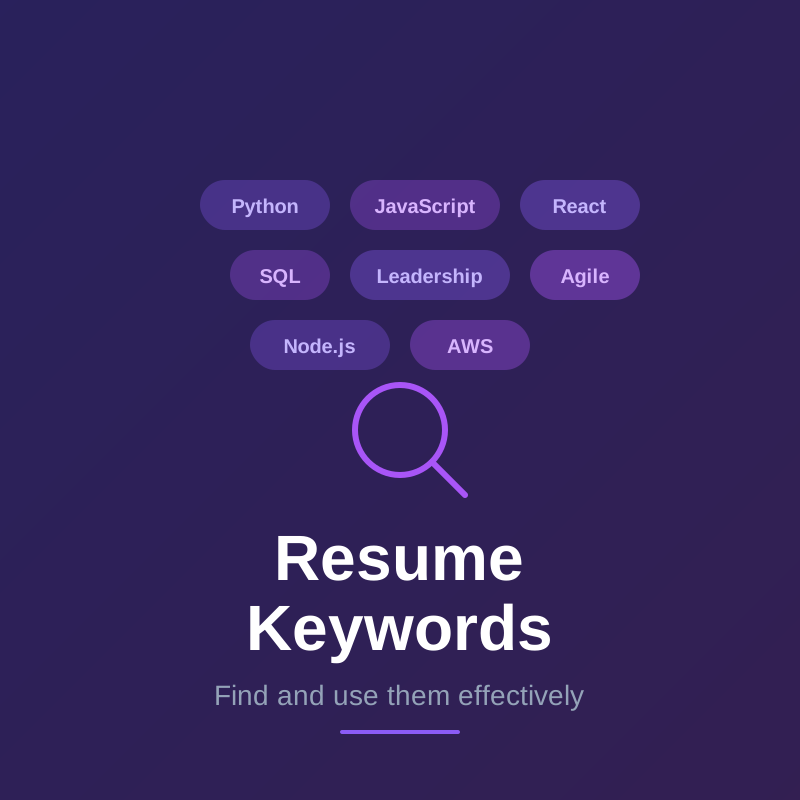
Keyword frequency and placement. Keywords that appear multiple times and in high-priority sections (job titles, skills section, summary) carry more weight than keywords mentioned once in a bullet point. Placing your most important keywords in the skills section and your most recent job title optimizes this signal.
Required vs. optional qualifications. Most ATS platforms distinguish between required qualifications and nice-to-haves. Missing a required keyword reduces your score significantly more than missing a preferred one. Focus first on matching 100% of required qualifications.
Exact vs. semantic matching. Older ATS systems require exact keyword matches — "project management" and "managing projects" are treated as different terms. Newer platforms use semantic matching and recognize synonyms, but exact matching is still safer. Mirror the job description's exact language wherever possible.
Section recognition. For the ATS to correctly score your experience, it first needs to correctly identify which sections contain your skills, work history, and education. Non-standard section headings prevent this. When the parser can't categorize your content, that content doesn't contribute to your score.
Years of experience and recency. Some platforms extract years of experience from your work history and score them against stated requirements. More recent experience carries more weight.
How to improve your ATS score
Mirror the job description's language exactly. Go through the requirements section of the posting and identify every keyword, tool, technology, and qualification. For each one you genuinely have, ensure it appears verbatim in your resume. Don't paraphrase — if the job says "stakeholder management," use that exact phrase, not "managing stakeholders."
Add missing keywords to your skills section. The skills section gets high weight in ATS scoring. If a keyword from the job description is missing from your skills list but you have that skill, add it using the exact terminology from the posting.
Fix formatting issues. A keyword-rich resume still scores poorly if the ATS can't read it. Tables, text boxes, multi-column layouts, and image-based PDFs all prevent the parser from reading your content correctly — which means those keywords don't count toward your score. Start with making your resume ATS friendly.
Use standard section headings. Rename any non-standard sections to standard labels: Work Experience, Education, Skills, Summary, Certifications. If the parser can't identify your work history, that experience doesn't score.
Include keywords in multiple sections. A keyword that appears in both your skills section and your work experience bullets scores better than one that appears only once. For your most critical qualifications, mention them in both places naturally.
Target roles where you meet 70%+ of stated requirements. If you're missing 8 out of 15 required qualifications, tailoring won't close that gap — role fit is the issue. Focus your optimization effort on roles where you genuinely meet most of the requirements.
Can you see your ATS score?
Almost never. In the vast majority of hiring processes, candidates do not receive their ATS score or any feedback about how their resume was ranked. The system processes your application silently.
There are a few exceptions:
- Some job boards (LinkedIn, Indeed) show a "% match" or "skills match" indicator on job listings before you apply — this is a simplified version of what ATS would score
- A small number of companies use platforms that show applicants a match score after submission — but this is uncommon
How to estimate your ATS score yourself:
- Copy the job description's requirements section
- Go through your resume and check each requirement: does the exact term appear verbatim?
- Count how many required qualifications you match vs. the total listed
- That percentage is a rough proxy for your ATS match rate
A more reliable method is to use a resume scoring tool that runs the actual keyword comparison. Finding the right keywords systematically from any job posting is the core skill.
Frequently asked questions about ATS scores
What is a good ATS score? A score of 70–80% is generally considered strong, and 80%+ is very competitive. Below 50% is unlikely to reach human review for competitive roles. The threshold varies by role and applicant pool size.
What does an ATS score of 80 mean? An ATS score of 80% means your resume matches 80% of the keywords and requirements in the job description. This is a very competitive score and means your application is highly likely to reach human review.
What is ATS score meaning in recruitment? In recruitment, an ATS score (also called a match rate or fit score) is a percentage that shows how closely a candidate's resume aligns with the job description. Recruiters use it to rank applicants — those with higher scores appear at the top of the review queue.